
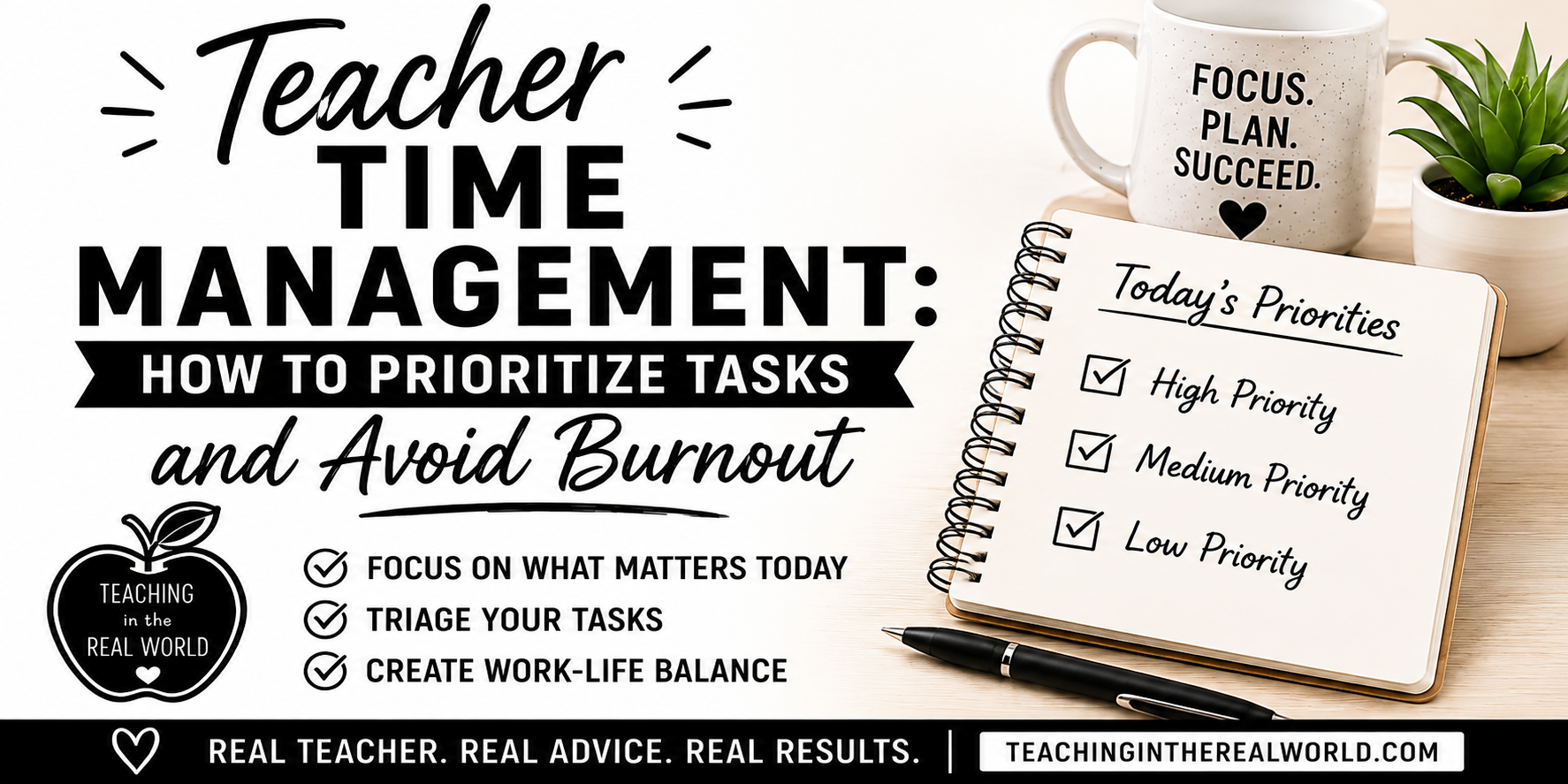
Teacher Time Management: How to Prioritize Tasks & Avoid Burnout
Do you find yourself working long hours in your classroom every day?
Do you feel as though you are always behind and nothing is getting done?
Are you constantly putting in more hours in an attempt to get ahead, just to be left feeling burnt out?
If these questions sound even a little familiar, then I have the Task Management System for you! I have been a burnt-out mess more times than I can count, and with the average teacher workload, who can blame me? Which is why I knew I needed to make a change. I developed a teacher system to help me focus on what needed immediate attention, leave what could wait until tomorrow, and most importantly, end my workday at a reasonable hour, while feeling accomplished.
You can have work-life balance with these teacher productivity tips! Let me walk you through my realistic teacher routine that you can begin to implement tomorrow. Stay consistent, and before you know it, these strategies will become a habit and likely seep into other parts of your life to help reduce even more stress!
What Does Triage Your Tasks Actually Mean?
The Merriam-Webster Dictionary defines the term triage as: the assigning of priority order to projects on the basis of where funds and other resources can be best used, are most needed, or are most likely to achieve success.
This definition is quite accurate regarding what I do each day in my classroom and, subsequently, my personal life.
So when I say that you need to triage your tasks, I mean this…
- Prioritize your tasks; decide what is high, medium, and low priority.
- Focus on what needs to get done TODAY.
- Accept that not every item on the to-do list can be completed today.
When you can triage your tasks and focus on what needs to be done right now, you can eliminate the tasks that are not a priority and leave them for another day. Remember, your tasks will get done; it just might not be today.
The Mantra That Keeps Me on Track

As a teacher, I know that the feeling of being overwhelmed and the possibility of spiraling are always looming over you, so I created a mantra, a quote really, that I repeat to myself all day long. This helps me to feel grounded; it helps to put things into perspective, and best of all, it pauses the spiral.
What do I need to do today, to be successful tomorrow?
That is it, this one little saying helps me re-calibrate, look at my to-do list, and triage my tasks. I am going to focus on the tasks that need to be completed today so that tomorrow can go well. I do not have the time to worry about the following:
- Things that are due in two days from now.
- Things that need to get done a month from now.
- Things that need to get done by the end of the school year.
Stay in the present and focus on the here and now.
Remember…What do I need to do today, to be successful tomorrow?
You will be happier, feel more productive, and, best of all, you will be prepared for the next day.

How to Sort Your Tasks
When you triage your tasks, it comes down to one simple thing: you must be in tune with your priorities and what needs to get done first. So, the first thing to do is to take a good, hard look at your tasks and realize what their triage levels are: high, medium, or low.
Here are some examples:
High
- Prepare Lessons for the Next Day
- Grading
- Student Data
- Parent Emails/Parent Communication
- Administrator Emails
- Meeting Prep for the Next Day (parent meeting, IEP, team, committee, etc.)
Medium
- Team Projects
- Tasks Due in Three Days to a Week
- Lesson Planning for the Subsequent Week
- Student Project Planning
- Special Projects/Committees
- Copies
- Teacher Desk Upkeep and Classroom Organization
Low
- Classroom Clean Up (pencil sharpening, desk cleaning, classroom library)
- Items Due a Month from Now
- Tasks Due by the end of the School Year
- Bulletin Boards
- Cupboard Reorganization
These are only a few examples, but it is important that you can see the significance of tasks and how they affect your day. If you cannot prioritize your tasks, you will not be able to triage your tasks. Obviously, the most important task each day is to ensure that your lessons are prepared and you have all the supplies you need to teach that lesson the next day. Grading should also be a high priority, as student scores are what should drive your instruction. Communication with parents and administrators is always high on the list; you are a professional, and responding within a 24-hour time frame conveys that message. You never want to attend a meeting and not be prepared, so make sure you are set for any meetings you have the following day. Again, you are a professional!
Here are some examples of special projects or tasks that can be completed little by little when you have free time- those “Medium Priority” items.
- Parent Teacher Conference Prep
- Data Committee Meeting
- Team Meeting
- Monthly Newsletter
- Prep for Upcoming Student Project
- Curriculum Night Prep
Once you can put your tasks into different “buckets,” you will be able to triage them with ease! Don’t forget: What do I need to do today, to be successful tomorrow?
Eliminate Tasks!

If you want to create a work-life balance and really make this realistic task management system work for you, you are going to have to let go a little. Now, I know that this is so hard for so many teachers, myself included. In the end, this will be amazing for your mental health.
Start with the tasks that cause you the most anxiety, the ones that you avoid the most. These are the tasks that you don’t enjoy, and they could possibly be the tasks that are NOT benefiting you and can be eliminated! You can use my flow chart to help guide you through the process, but here are some questions you will want to ask yourself:
- Does this task make my life easier?
- Does this task affect my success tomorrow?
- Can this task be broken into smaller, more manageable pieces?
- Can someone else (a student, parent volunteer, or teammate) take this task on?
A lot of times, we take on too much as teachers. We want to be in control, or at least I did, but I found that once I started relinquishing control, I was happier.
Here are some things I stopped doing:
- Sharpening pencils and organizing supplies (this became a student job).
- Organizing the classroom library (once I stopped, miraculously, students started to take care of it).
- Making copies (I communicated my need and got parent volunteers).
- Committee Involvement (I chose the committee that I was most passionate about and quit the rest).
- Keeping up with unattainable planner and notes goals (I switched to a spiral notebook and a desk calendar).
- Trying to keep papers and handouts together for absent students (I adopted the Extra Papers Bin).
- Searching for the perfect charts, posters, worksheets, notes (I create my own anchor charts and use Interactive Student Notebooks).
- Socializing at school (my team and I now have a standing happy hour date once a week).
Stop doing the tasks that aren’t helping you. Eliminate the stressful tasks or tasks that take up too much of your time during the school day. Either pass the task on to someone else or eliminate it altogether. It was so liberating to eliminate tasks that weren’t really helping me, and I have to say no one really noticed, and there wasn’t this huge negative impact that I imagined there would be.
Communicate Your Boundaries!
When you triage your tasks, it is important to communicate your boundaries regarding the different tasks that you manage each day. For example, parent communication is definitely on the high-priority list…but not all communication is time-sensitive. Your team and the tasks for your grade level are definitely important, but do they need to be done right this second? You love being a part of your campus community, but you can’t be on every single committee or board.
Here are some ways that worked regarding communicating my boundaries so that I could simplify and triage my task list:
- Send a letter to parents to inform them about your 24-hour communication policy (all emails and phone calls will be returned within 24 hours).
- When working with your team on projects, goals, or upcoming events, set a timeline and due dates.
- Choose the extracurricular committee or board that you are passionate about! If there is kickback, let them know that you want to be able to give your all to one committee, not split your effort amongst many.
- Be clear with students regarding classroom upkeep and respect for the classroom and its contents. Assign jobs and put the responsibility on the students.
Remember, it is great to help everyone, it is great to compromise and pull your weight, but the best thing that you can do for yourself is to value your time. Set boundaries and do an amazing job; there is nothing wrong with saying no.
Triaging your tasks is an easy way to manage your time. By doing so, you are creating boundaries, routines, and systems that will benefit you and help you to avoid teacher burnout. Remember: What do I need to do today, to be successful tomorrow?