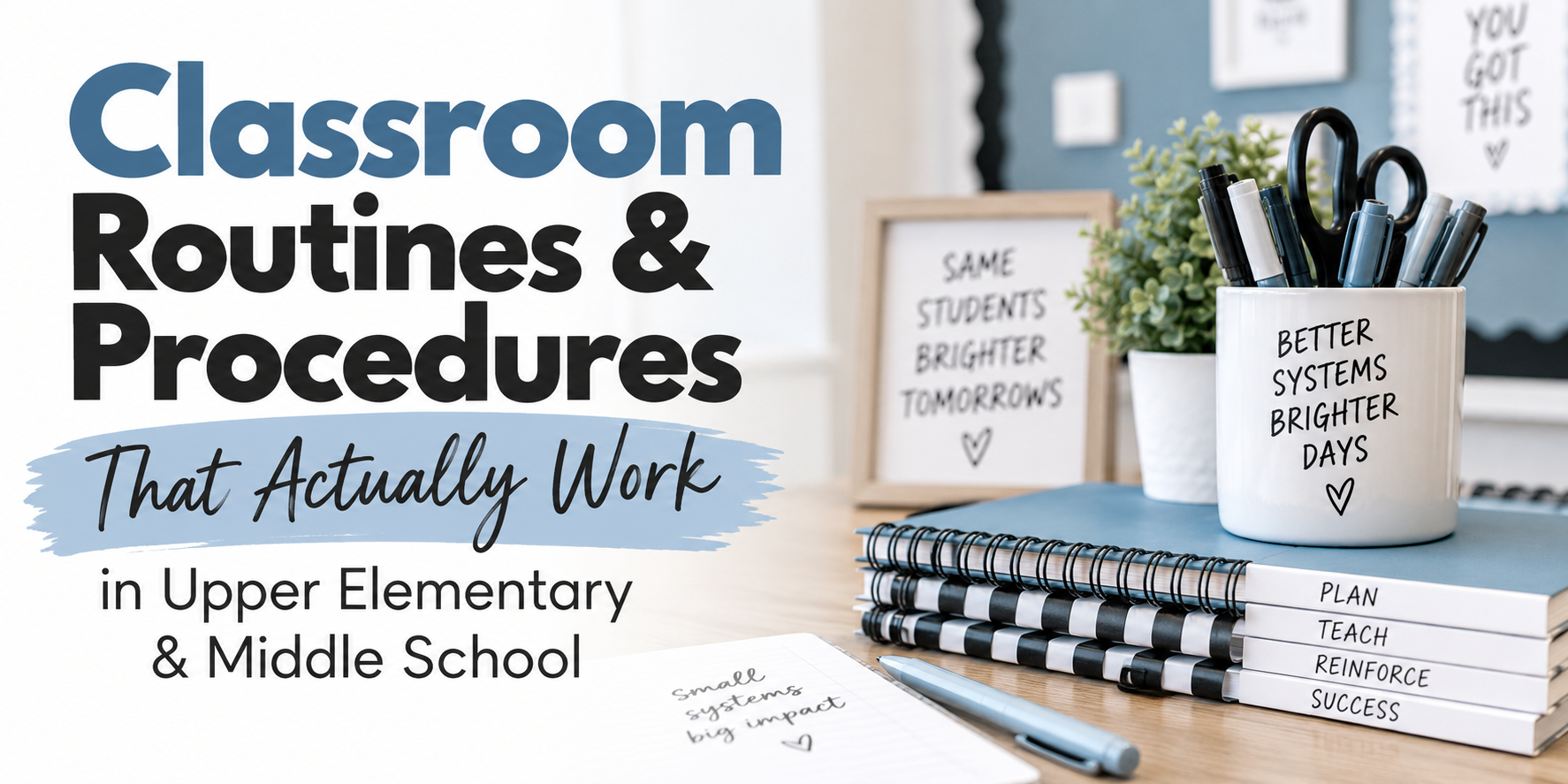
Classroom Routines and Procedures That Actually Work in Upper Elementary & Middle School
You have explained the procedure.
You have reminded them of the procedure.
You have probably said, “We have been doing this since the first day of school!” more times than you would like to admit.
And yet, somehow, students still walk into class and ask what they are supposed to be doing.
Sound familiar?
Classroom routines and procedures are supposed to make our lives easier, but that only happens when our students actually know what to do—and can do it without waiting for us to tell them.
That’s where classroom management really begins.
Great classroom management isn’t about having a perfectly quiet classroom or creating a rule for every little thing students do. It’s about creating predictable systems that clearly communicate what students are expected to do.
And those systems don’t have to be complicated.
In fact, the simpler they are, the better.
Classroom Management Is More Than a List of Rules
When teachers hear classroom management, behavior is usually the first thing that comes to mind.
But classroom management is also:
How do students enter your room?
Where do they turn in an assignment?
What happens when they are absent?
How do they get a missing paper?
What should they do when they finish an assignment?
How do you get everyone’s attention?
What happens during independent work?
How do students transition from one activity to another?
Those tiny moments happen over and over again throughout the school day. When students don’t know what to do, you become the system.
You answer the question.
You find the missing paper.
You remind them where to put the assignment.
You tell them what to get out.
You redirect the transition.
Again. And again. And again.
That’s exhausting.
The goal of good classroom routines isn’t simply to control student behavior. It’s to create a classroom that can function without the teacher managing every single movement.
Step 1: Figure Out Where Your Classroom Is Breaking Down
Before creating another procedure, look at the systems you already have.
Ask yourself:
What works?
What doesn’t work?
Where do I not have a system at all?
This is especially useful if you’re several weeks—or even several months—into the school year.
Think about the moments of your day that consistently frustrate you.
Maybe students take forever to get started.
Maybe you’re constantly being asked for missing assignments.
Maybe transitions are louder and longer than they need to be.
Maybe dismissal becomes chaotic.
Those frustrations are actually giving you useful information.
If the same classroom problem happens repeatedly, there may be a missing or ineffective system behind it.
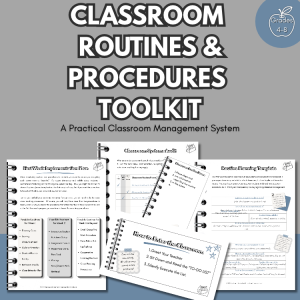
That’s why the Classroom Routines & Procedures Toolkit starts with a Classroom Systems Audit. Instead of trying to change everything, you identify which systems work, which don’t, and which ones you still need.
Step 2: Decide Which Classroom Procedures You Actually Need
You do not need a 12-step procedure for sharpening a pencil.
Upper elementary and middle school students need structure, but they also need opportunities to become independent.
I like to save procedures for the parts of the classroom that need a consistent system.
Some of my must-have classroom routines and procedures include:
- Entering the classroom
- Leaving the classroom and dismissal
- Calls to attention
- Assignment turn-in
- Paper pass out and pass back
- Missing and absent work
- Bathroom breaks
- Student planners or agendas
- Interactive student notebooks
- Small-group and independent work
- Cooperative learning
These are the kinds of routines that affect how the entire classroom operates.
Something simple, like sharpening a pencil, doesn’t necessarily need an elaborate procedure. In my classroom, students simply knew that they could sharpen a pencil when I wasn’t talking or at the beginning of class.
That’s it.
Create systems where systems are useful. Give students independence where independence makes sense.
Step 3: Know Exactly What You Want Students to Do
Here’s where classroom procedures often fall apart.
We know what we don’t want students to do.
Don’t run into class.
Don’t yell across the room.
Don’t interrupt me while I’m teaching.
Don’t leave papers on my desk.
But what do you want them to do?
Before teaching a classroom routine, I want to be able to answer four questions:
What do I want students to do?
How will I make sure they know how to do it?
What is my responsibility?
What is the student’s responsibility?
That distinction is important.
For example, if I want students to find missing assignments independently, I need to create a place where those assignments can actually be found.
My responsibility might be maintaining an Extra Papers Bin.
Their responsibility is checking that bin before asking me for another copy.
Now we have a system.
The toolkit’s Routine Planning Template is built around exactly this process, including a space for enforcement and clarification so the procedure doesn’t disappear after you’ve introduced it.
Step 4: Actually Teach the Routine
We teach students how to divide fractions.
We model how to annotate a text.
We practice how to write a constructed response.
Then sometimes we say:
“Okay, when you come into class, get started right away.”
And we’re surprised when 30 students interpret that direction 30 different ways.
Classroom procedures have to be taught just like academic skills.
I use a simple five-step process:
1. Name the routine.
Tell students exactly what you’re teaching and why it matters.
2. Give the directions step by step.
Keep the steps short and clear.
3. Give students a visual reference.
This might be an anchor chart, a slide, or a small reference students keep in their interactive notebook.
4. Model it.
Don’t just tell them. Show them.
And then let them practice it.
5. Reinforce it.
Notice when students are doing it correctly. Redirect when necessary. Practice again if the routine starts slipping.
That’s the same process I use in the toolkit for teaching an entering-class routine. Students don’t simply hear the directions—they see them, discuss them, watch them modeled, and actually practice leaving and re-entering the room.
It takes a few extra minutes at the beginning.
It saves a lot of minutes later.
Step 5: Don’t Teach Everything on the First Day
This one is especially important.
Teachers have a lot to cover during the first few days of school, and it’s tempting to explain every classroom procedure immediately.
Bathroom.
Pencils.
Binders.
Homework.
Missing work.
Groups.
Technology.
Dismissal.
Supplies.
Turn-in procedures.
By the end, students aren’t going to remember half of it.
Less is more.
I prefer to introduce the routines that have the biggest impact on classroom flow first and then layer additional systems in as students need them.
For example, during the first week you might concentrate on entering and leaving class, getting students’ attention, bathroom expectations, planners, and your classroom behavior system.
During week two, you can add systems such as assignment turn-in, paper distribution, interactive notebooks, and retrieving missing work.
More specialized procedures—small groups, data folders, cooperative learning, close reading—can come later.
That’s the progression built into the toolkit’s First Week Implementation Plan and three-week planning pages.
You don’t have to create your entire classroom management system in one day.
Build it as you go.
What If It’s Already the Middle of the School Year?
Start over.
Seriously.
You are allowed to reset a classroom routine that isn’t working.
You don’t have to keep living with a chaotic transition in November because that’s how you’ve been doing it since August.
Tell your students:
“This isn’t working as well as I want it to, so we’re going to try something different.”
Then teach the new procedure exactly as you would have taught it at the beginning of the year.
Explain it.
Model it.
Practice it.
Reinforce it.
A classroom reset isn’t evidence that your classroom management failed.
Changing a system that doesn’t work is good classroom management.
Classroom Routines Should Make the Teacher Less Necessary
This is ultimately my test for a good classroom system:
Can my students do this without me?
Can they enter class and get started?
Can they find the paper they missed yesterday?
Can they turn in an assignment?
Can they transition to independent work?
Can they figure out what they’re supposed to be doing without asking me?
The more students can manage those predictable parts of the school day independently, the more time and energy you have available for the part that actually needs you—teaching.
That’s the classroom-management goal.
Not perfection.
Not silence.
Not controlling every movement.
Clear expectations. Predictable systems. Independent students.
Need Help Planning Your Classroom Routines and Procedures?
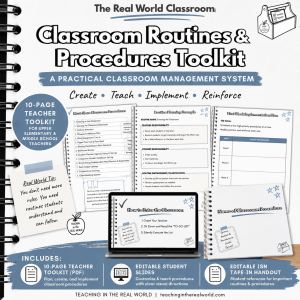
If you know some of your classroom systems aren’t working but aren’t sure where to start, I created the Classroom Routines & Procedures Toolkit specifically for upper elementary and middle school teachers.
It walks you through the process of identifying the routines you need, auditing the systems you already have, planning each routine, determining teacher and student responsibilities, teaching procedures explicitly, and creating an implementation plan.