
Grading Strategies for Teachers: How to Stop Taking Papers Home
Keeping up with grading is one of the biggest time-management challenges teachers face. If you’re constantly taking stacks of papers home, grading at night, or feeling buried under student work, it’s time to change your grading system.
These grading strategies for teachers helped me stop taking papers home while still giving students timely feedback. With a simple system for deciding what to grade, what to acknowledge, and when to enter grades, you can keep up with student work during the school day and protect your time at home.
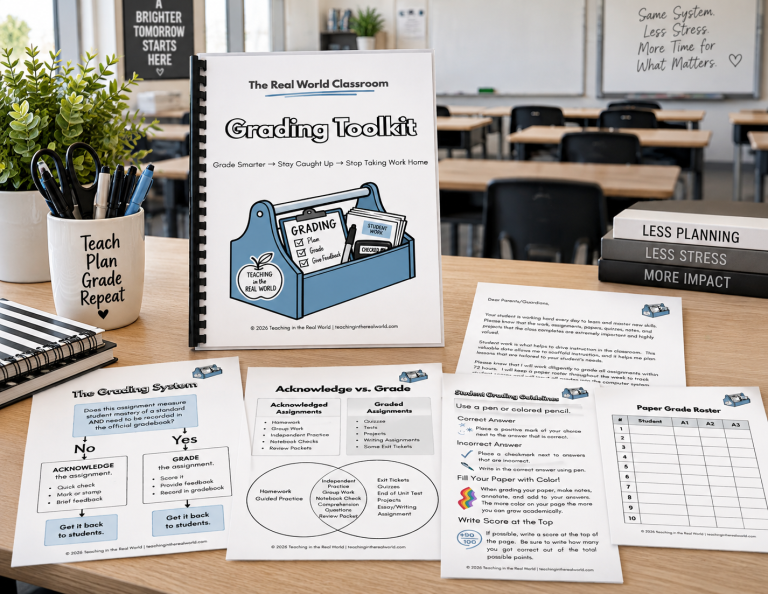
I already know what you are thinking: STOP taking assignments home to grade??? Finish grading at school? IMPOSSIBLE!!! We all know that upper elementary and middle school classrooms produce a ton of assignments and require quick feedback for students; however, I assure you that my real-world teacher grading system will let you get it all done during your school hours. My system will teach you how to grade quickly, set up your grade book efficiently, and use every possible moment to get those assignments scored. Teacher burnout is real, and it comes fast. By implementing my grading system, you can keep your head above water and the flames of burnout at bay.
How to Keep Up With Grading Using the 72-Hour Rule
The first step to finishing your grading at school and NOT taking anything home is establishing and sticking to your grading goals. A commitment to grading/acknowledging all student assignments within three days ensures that there will be no papers cluttering your desk. Your tote bag will not be filled with student assignments carted back and forth from school to home, often untouched. The papers are graded and returned to students or placed into data folders within three days.
How to Grade Papers Faster Without Taking Work Home
Every day is a marathon of non-stop work, I know! So, the biggest question on everyone’s mind is: When am I supposed to get all of this grading done? I have got you covered!
1. You must change your grading mindset: All papers will be acknowledged, but only some papers will be graded.
It is insane to grade every single assignment that your students complete. There is literally not enough time in the day. However, you students still need your feedback and your validation, so you will physically acknowledge every single assignment completed. You will grade the assignments that show students’ progress in mastery (formative and summative assessments). Not quite sure what I am talking about? No problem, keep reading; I promise this shift in your thinking will eliminate your grading stress forever!
Acknowledged assignments are looked through and stamped while students are working on their warm-up at the start of class, completing an exit ticket at the end of class, or during any type of transitional time when you can take a couple of minutes and look through the papers. That is the great thing about acknowledging these assignments: you can do it quickly and effectively! Graded papers are attended to during prep periods and after school. You need to focus when grading, so you will have to complete this at a quieter time during the day. Manage your time and get home at a reasonable hour. The goal is to have your acknowledged papers completed on the same day they are submitted and your graded papers scored and recorded within 72 hours. Do not take any papers/assignments home to grade!
2. You must be as productive as possible throughout your day.
The question of when you will have time to complete all the grading is still pending, but I assure you it can be done. I can meet this timeline, and that is with five classes and 170 students. The key is how you manage your time. You have to manage your time at school and keep your socializing, scrolling, wandering, and all other off-task time suckers to a minimum.
Now, I am not telling you to lock yourself into your classroom and never speak to anyone; that is just crazy! But if you do a true audit of your time, you will find that a lot of it is spent on tasks that do not need attention at that time, or your time is spent doing things that are not productive. I do not want to detour you from building relationships with other teachers or your team either; those bonds are so important, and as we all know, only teachers truly understand what a teacher is going through. However, I encourage you to limit this, or to make time after school, or on the weekends, in a more social setting. If this doesn’t work, because we all know too well how busy life can get, choose times to socialize throughout the week. For example, I would make an effort to eat lunch with my team three times a week; it felt good to connect and catch up, but it also freed up time during the other parts of my day. It might only work for you to do this once a week, or maybe your lunches aren’t at the same time, so consider extending that team meeting by an additional ten to fifteen minutes to allow time to vent. Communicate with your team about your goal to complete grading at school, share the plan with them, and I bet they will want to jump on board as well. You will be able to find the balance that works for you, but in the end, not taking work home will improve your quality of life more than you know, and that is worth a little less social time at school.
A Simple Teacher Grading Strategy: Acknowledge Instead of Grade Everything
Let’s get down to the nuts and bolts of my grading system, and the first thing you must do is change your mindset. There is no way to grade every single assignment or go through and score every single question. You must adopt a specific phrase to keep you on track. Write it on a sticky note and keep it in your grade book.
The key phrase to accept and adopt is: “All papers are acknowledged, only some are graded.” Every assignment turned in will be looked at and acknowledged; papers that are only acknowledged are not being entered into the grade book (homework, group work, some independent practice, some exit tickets, etc.).
What does acknowledgement of an assignment look like? When you acknowledge an assignment, you are placing a clear mark at the top of the page to indicate that you have seen the assignment. This mark needs to be quick and easily seen as a teacher’s mark. I prefer to use rubber stamps; they are quick and really stand out at the top of the page. With a stamp, there is no confusion as to who made the mark or if it is a silly doodle. My stamps were always Peanuts-themed (as was most of my classroom), so parents know it is from me; however, there are a slew of stamps with sayings that are made for teachers as well. It really depends on your preference. Sometimes, in addition to the stamp, a quick note would be jotted if needed, but the idea is a quick look over and acknowledgement, and then on to the next paper.
Why is it important to acknowledge every assignment? You want your students and their parents to know you are paying attention. You see the work that is being turned in, you have made note of progress, and you are aware of the students’ efforts. When you acknowledge an assignment, you have just given that assignment power, in turn allowing students to feel accomplished within their learning, and allowing parents to see that their students have completed an assignment.
The process for acknowledging an assignment looks like this:
- Take 1-3 seconds to look over the assignment.
- Use a rubber stamp at the top of the page to acknowledge that you have checked the assignment.
- Stamps are quick, easy, and cheap. They can be used year after year.
- I can change the stamp based on my mood, assignment, or time of year. Using different stamps on different assignments shows that assignments were graded on different days.
- The stamp notifies students and parents that the assignment has been looked over by a teacher, that the student’s work has been acknowledged, and that the teacher has made note of student progress.
- Circle any big mistakes or missing work on the assignment (whatever you can spot in three seconds); jot a quick note if needed.
How to Decide What to Grade and What Not to Grade
Typically, acknowledged assignments have been graded by students or peers. They are never tests, quizzes, or anything that measures the student’s mastery of a standard; these assignments are the work leading up to those assessments and graded assignments.
Homework
Independent Practice Activities
Group Work Activities
Warm Up Activities
Review Worksheets
Notebook Check-In
Guided Practice Activities
By acknowledging their work, you are still able to see how students are performing and can connect with them during your intervention group. Then, you place the papers in your “Pass Back” bin, and they are sent home ASAP. The acknowledgment of these assignments lets your students know that you are paying attention; it keeps them motivated, and it helps to keep the stacks of papers on your desk small.
How Many Assignments Should Teachers Grade Each Week?
The assignments that measure a student’s mastery of skills should be graded, not just acknowledged. This includes formative assessments, summative assessments, exit tickets, or independent practice. Assignments that are graded take a little longer, and you will be checking every single question, marking answers incorrect, and placing a score at the top of the page.
Why Three Assignments?
After years of fine-tuning my grading system, I have figured out that three grades per week give the most accurate snapshot of each student’s learning. Now, I am not suggesting that you input three 60-question tests each week, but you might have a five-question exit ticket, a twelve-question quiz, a paragraph from an essay, notes on a chapter read, etc. You must commit to entering three scores from graded work into your grade book each week. I typically do this on Fridays during my prep period, using my ten-key keypad, and quickly input grades from a paper roster where I have been recording scores throughout the week.
Use a Paper Grade Roster to Save Time
I prefer to enter all of my grades on Friday using my ten-key pad; it is quick and only takes about twenty minutes. However, you want to pass back the assignments as soon as possible, so recording the scores onto a paper roster is a quick and easy way to keep a record of the graded assignments. This also allows you to see who has not turned in the assignment, who still needs to finish the assignment, or who did not place their name on their paper. Jotting down the score on the roster should only take a quick second, and if you are following my quick and easy data tracking technique, click here; you will already be in recording mode. When it comes to grading, scoring, and time management, efficiency is key; recording scores as you go will save you time and give you an instant visual of the class’s progress.
Which Student Assignments Should Teachers Actually Grade?
“Graded” assignments operate a little differently from assignments that are simply “acknowledged.” These are the assignments/assessments that are entered into the grade book and are used to measure student mastery of a topic. Oftentimes, graded assignments/assessments will also be recorded into students’ data folders, and a test talk will be conducted. Here are the guidelines for a “GRADED” assignment:
- Take 2-5 minutes to grade every question on the assignment, assessment, practice, etc.
- All incorrect answers are marked.
- Mistakes are marked: grammar errors, numerical inaccuracies, transposed numbers, etc.
- Notes of reinforcement and/or refinement are written as needed.
- The assignment is stamped for acknowledgment (this provides consistency with ALL assignments)
- The numerical score/percentage is written at the top of the page.
- The students’ scores are recorded on a paper roster.
- Written scores can be entered into the electronic grade book at a convenient time.
- Recording the score allows papers to be passed back as soon as all assignments are graded, which eliminates another stack of papers.
How to Organize Your Grade Book Efficiently
Three assignments each week give you a well-rounded and accurate depiction of students’ abilities throughout the quarter. In addition to the three assignments each week, it is also my experience that weighting your grade book is extremely beneficial in creating accurate grades to depict a student’s mastery of concepts; these weights give parents and students a realistic picture of the student’s mastery and ability level for the week based upon the three assignments entered. My grade book consists of these weighted groups:
- Participation 25% (homework, completion of tasks like ISN checks and notes, group work)
- Classwork 25% (any type of independent practice)
- Assessments 50% (formative and summative)
I also suggest using a paper roster to record students’ scores as you are grading. This makes it easy to enter the grades into your grade book on a day that works for you, and it also allows you to pass back those papers as soon as possible since you already have the grade/score recorded (fewer papers on your desk). By committing to grading three assignments each week, you are going to find that your student data is accurate, and even better, your knowledge of the class’s progress is spot on! No stress at the end of the quarter; you are caught up and have plenty of grades in the grade book.
Why Teachers Should Return Graded Work Quickly
You have worked hard to keep up with your grading, to keep those stacks of paper to a minimum- now get rid of them! It is just as important to pass back the assignments to students quickly as it is to get them graded quickly. Sending student work home helps parents to see how students are doing, and it gives students the feedback and reinforcement that they need. This quick feedback allows your students the opportunity to make changes on the next assignment, so give those papers back!
Test Talks need to happen within that 72-hour window of grading assignments/assessments as well. If you want to reap the benefits of all of your hard work grading, then it is vital to have that Test Talk as soon as you can! The idea of a Test Talk can seem daunting, but it makes a world of difference and should take 15 minutes maximum! If you need some guidance on Data Folders or Test Talks, check out my Teacher Resources– I have got you covered!
In addition to benefiting students and parents, passing back those acknowledged and graded assignments helps to declutter your desk and your mind. Get those papers out of your way; you have so many other productive tasks to get to.
I think it is safe to say that grading assignments is one of the least desirable tasks a teacher must do, but it is also the most valuable! By staying on top of your grading, you have your fingers on the pulse of your students’ progress and their academic needs. Parents will love the papers coming home daily, and students will appreciate the acknowledgment of their hard work. Test Talks and data folders can be completed and updated in a timely fashion, making the test data meaningful to students and their progress. This is absolutely a win-win! Try this strategy, and I promise you will never go back to piles of papers on your desk.