Classroom Organization Made Easy | My Realistic Summer Purge
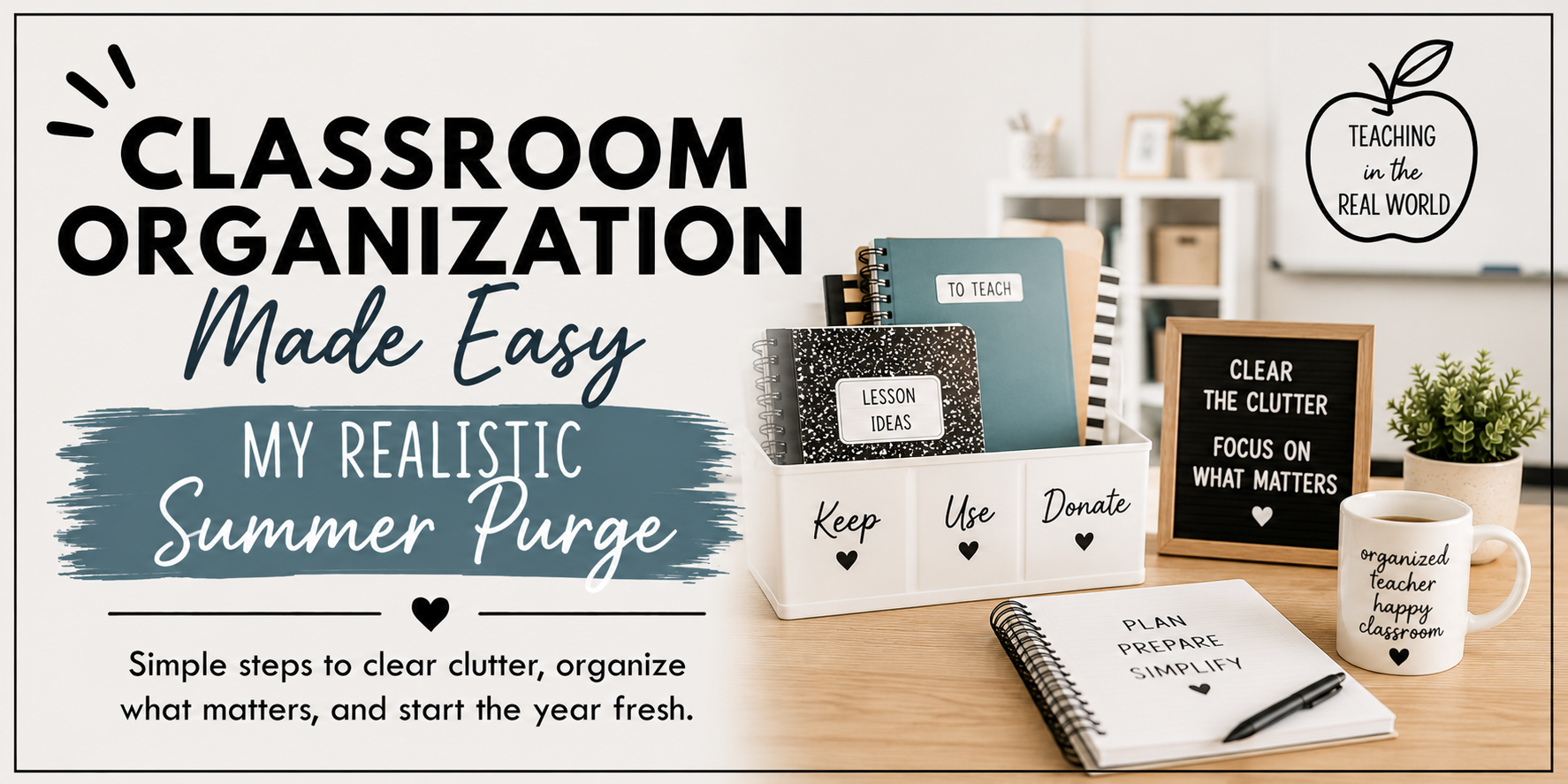
The end of the school year is super hectic! Most teachers are burnt to a crisp and overwhelmed with end-of-the-year tasks. Teachers are ready to draw the blinds, lock their doors, and head home for a much-deserved breather. I have been there, but I encourage you to take the time to go through your cupboards, filing cabinets, drawers, shelves, carts, and any other space that holds supplies, teaching tools, papers, books, etc. Let go of all the things cluttering your classroom, and in turn, your mind. Summer classroom prep will make your return in the fall much easier.
I know what you are thinking: I will clean my classroom when I return from summer break. I have said that many times over the past twenty years, and it never quite works out. We all know that by the end of summer, you are scrambling to get everything done in your personal life, as well as prepping for a new school year. Plus, once you return to campus, your schedule is packed with meetings and professional development, leaving you little to no time to go through your classroom. Use the last two weeks of school to get things organized, throw things out, and declutter. Enlist the help of students, the I.T. Department, and other teachers. Get things organized, donated, shredded, and tossed before you head out for summer break–your future self will thank you during the first week back in the fall–believe me!
Don’t worry; I have real-world clean classroom ideas to help your summer classroom prep, and in the end, you can truly relax during your time away.
Where Can “Stuff” Go???
Before you begin getting rid of any items in your classroom, first determine where they can be sent, donated, or gifted. Remember, not all items in your classroom need to stay there for you to keep them.
Check with Custodial Staff
Most campuses have some storage, whether it is a room, a shed, or a storage unit. Check in with the custodial staff to see if this is an option; if so, then this is the perfect opportunity to pack up items that you want to keep, but maybe aren’t working for the current grade level that you teach. This can also be an option for items that you only use once a year, for example, classroom novel sets, science projects, extracurriculars like student council elections, etc. If you have space within your personal storage, either at a facility or at home, this can work too, but I suggest using the school’s storage option if possible. Your classroom is likely not huge, so freeing up any space with items that are not used regularly can make a big impact.
Touch Base with the School Secretary
We all know that on most campuses, the school secretary knows all! Check in with the secretary to see if the school is partnering with any local charities, churches, or donation centers. If your campus does partner with a charity, there is likely an area you can place donated items to be picked up (which makes your life easier); if not, then you will need to find your own donation center.
You will also want to verify with your secretary the school’s policy on placing “free” items in the teacher’s lounge or copy room. Make sure that it is okay for you to place items up for grabs in these areas. Typically, other teachers are happy to take items you are getting rid of, but make sure to revisit the items you have put out, and clear them away within a week if no one has decided to rehome them.
Teacher “Garage” Sale
Another great option is to email other teachers in the school and invite them to your classroom to peruse the items you are getting rid of, and to rehome them. Put a fun spin on it and organize it as a teacher garage sale; believe me, other teachers on your “block” will likely participate as well. The great benefit to this is that you don’t have to haul your items anywhere, and you can work in your classroom while your “customers” come to you.
Start with the Stuff That Isn’t Yours
Have you ever heard of Swedish Death Cleaning? It is the idea that you declutter your life so that when you die, you don’t pass on your clutter to your family and friends. Well, many of us wish that teachers would adopt this mindset! Every classroom I have ever moved into is filled with the other teachers’ clutter. Whether it is student files, VHS tapes, a box of wires, or old textbooks that are not from this decade, you are not required to keep their clutter. Start purging these items that you have inherited that are of no use to you. Free up that space; it is not yours to keep.
Get Rid of Antiquated Tech
Do you have an actual overhead projector in your classroom? An old document camera, a box full of wires, or tablets that don’t work? Maybe you have computers that are piled in a corner, covered with dust, and they haven’t been turned on–ever??? Get rid of any technology that does not work or is not used in your classroom. Old tech can take up a lot of valuable storage space, so contact the IT Department in your district and send it to them! Box up the tech and ship it through district mail–get it out of your classroom. The IT crew will know what to keep, what to donate, and how to dispose of any tech that is not usable. Deep breath…that is another cluttered weight off of your shoulders.
Next…Get Rid of Antiquated Materials
If you have textbooks from a previous decade that are not up to date or used, it might be time to let them go. If your state standards changed, and you have no use for specific math manipulatives, get them to the appropriate grade level. You have no use for learning materials that do not teach the correct information. Contact the curriculum department to see if they want old textbooks, teaching materials, or manipulatives. If no one wants these materials, it is time to donate them or send them to recycling. It is not your job to house these items–you need the space!
Your Stuff
Hopefully, you are getting the hang of letting go, you are feeling good, you are seeing space freed up, and you are feeling lighter! Hold on to that feeling, because now it is time to take a real look at your stuff. You must be completely honest with yourself, and only keep the items that are working for you, your students, and your teaching style. If this feels daunting, ask yourself: What has the Most Dust?
Start simple…what has the most dust? Items with the most dust are items that you have not touched, and if you haven’t touched something within this last school year, you likely won’t use it next school year. Send off those math manipulatives, oil paints, workbooks, DVDs, and whatever else is collecting dust. Free up that space for learning tools, manipulatives, and supplies that you actually need. Getting rid of these items will help you be more efficient when planning; when you look at your supplies, you will actually see items that you can use and that will help your students. You won’t have to spend your time looking over, around, or under these items that are collecting dust. Plus, you could be giving someone else the tools that they have been wanting to try next year in their classroom, or even at home this summer with their own families. Let it go!
Shred It!
I have moved classrooms a few times in my two decades, and do you know what I always find in every single classroom I move into? File cabinets FILLED with student work, student files, student behavior sheets, and more! You don’t need to keep it! Save yourself, and anyone who might move into your classroom in the future, time and space–shred it! You DON’T need to keep student work, student files, or student behavior sheets. The only information that you should keep from your students should be filed in the office in the student’s main file folder. If the student has an IEP, then work samples and data should be housed with the special education teacher. All student work should be sent home, and their test scores and data that were recorded in their data folders should also be sent home. It is not your job to file and keep all of these documents. How many times have you ever gone back and looked at student files in your classroom? My guess is zero; free up valuable storage space and place those items in the shred bin.
What Should You Keep?
- Class or Subject Data Folders
- These are the folders that you used to record class and/or subject data (line plots, class averages for tests, etc.), and to model to the class what data folder expectations were.
- This is a great way to easily compare test scores from year to year, and everything is neatly compiled in a folder, easy to tuck away.
- Check out my free Teacher Resource to help set up your future data folders and to create a meaningful resource that you will actually use!
- Interactive Student Notebooks
- Keep the current year’s class and/or subject ISNs.
- These are a great reference for next year and will save you time and energy.
- You won’t have to look up definitions or terms; they are already recorded.
- Your ISN is an excellent reminder of which items you taped in and which foldables you used for any given topic.
- ISNs get better every year; referring back will help you to see what worked and expand upon it next year.
- Parent Communication Documentation
- Not sure what you should document? Check out my free Teacher Resources for help or guidance on the topic of Documentation.
- Keep documentation of your parent phone call communication, as this is to protect you more than anything.
- Parent email communication should be stored in a folder in your school email account.
- If you offered student help before school or during lunch, be sure to keep the student sign-in sheets/documentation (again, this is to protect you, just in case a parent decides to contact administration over the summer).
As you can see, you don’t need to keep copious amounts of files, student work, or tests. I assure you, these items were the only things that I ever needed to refer back to, and you will be free and clear if this is all you store and file. By only keeping what you need, you save yourself the headache of clutter and open up the gift of space!
Incomplete…
Next, tackle the incomplete sets, or items that there are not enough of to do anything with.
Do you have a bunch of leftover bulletin board borders? Not quite enough to go around a board? Time to get rid of them! A bin of broken crayons? Buh-bye! Dried out markers, chewed pencils, board games, or puzzles with missing pieces? See ya! You don’t need to keep these items; they are not helpful to you. If anything, they are frustrating! If the item is something you can’t use, don’t keep it. Now, I know that the teacher inside of you is screaming that these items can be used; they can’t just be thrown away. If this is you, then here are some suggestions to pay the items forward and give them a new lease on life.
- Bulletin Board Borders
- Students can cut them to create bookmarks.
- Cut the borders and have your students create mosaic art with the pieces.
- Pass them on to another teacher.
- Broken Crayons
- Offer them to the art teacher for future projects (picture frames, melting, etc.).
- Offer them to students and parents (broken crayons still work).
- Melt them together to create new crayons (only choose this option if you have the time and will actually do it; otherwise, toss them).
- Missing Pieces: Board Games and Puzzles
- Offer them to students to take home for the summer
- See if other teachers have the same game…maybe the pieces from the two can be combined.
- Offer them to the after-school program; they are always looking for ways to keep students entertained.
Housing incomplete sets or materials that cannot be used is cluttering your space and your mind. Let these items go, clear space for new items, and think of what you want to add to your wish lists for next year. You owe it to yourself and your students to have usable classroom supplies and activities; you and your students are worth it!
Classroom Library
The next area of your classroom to tackle is the classroom library. If you have ripped books, books with missing pages, books that have been written in, or are just falling apart, it is time to get rid of them. Offer them to the library, to students, or send them to the recycle bin. When you have damaged books in your library, students assume it is okay to mistreat the books. Set an expectation regarding your classroom library and how the books are treated, and students will hopefully follow suit. If you have a reading nook, pillows, or any type of seating, go through that as well. Is it stained? Smelly? Or just always in the way? It is okay to let that go, too. Having a clean and organized library is what will be welcoming to students; that is what will draw them in and help them to select the perfect book. Although it can be fun to have seating at the library, I found that it also created a lot of distractions, arguments amongst students, and I was always tripping over pillows! Don’t stress so much about creating a lounge area, but focus more on the act of reading and using books as a resource. Lounge area or not, the students won’t know the difference; what they will notice is books that are organized and easily accessible.
The last thing that you should do before you leave your classroom for the summer is pack up and clean. Depending on your school and your summer checkout requirements, this will look different for everyone, but I recommend taking down your bulletin boards and borders, word walls, and anything else that you have hanging up. Clear off your desk, organize your drawers, and make everything as neat as possible. Once you leave your classroom for the summer, take the time to reflect, to look at your school year, your systems (organization, classroom layout, behavior management, grading, etc.), and decide what worked and what didn’t. Start the next year fresh, updated, and ready to be an even more effective teacher. If you need some guidance with reflection and revamping your real-world classroom, check out my Teacher Resources.
In the end, a clean and clutter-free classroom will be inviting for both you and your students. It will create an environment where you and your class can think, explore, brainstorm, and above all, learn without distractions. You can do this!