How to Write Lesson Objectives That Improve Student Learning
The task of writing objectives for lesson plans can feel daunting, and the thought of posting them on your whiteboard each day can be intimidating. You might wonder: Why do I have to do this, and does it even matter?
If any of these questions have crossed your mind, then great minds think alike! I have asked these questions many times; in fact, I am such a dinosaur that when I first started teaching, posting your lesson objective was not a requirement, it wasn’t even on my radar. Lesson objectives were reserved for the dreaded formal observation, and that was literally the only time I thought about it.
But then…something happened, a shift in the education world. Lesson objectives became a requirement. Administrators were cruising classrooms with the sole intent to check for posted lesson objectives. So, I did my due diligence and begrudgingly posted my objective every day. It wasn’t until I was in the midst of a teacher breakdown, feeling burnt out and overworked, that I realized I did not have the energy to keep resisting the idea of lesson objectives. So, I did what I always do, quietly freak out and overthink everything for a couple of days, have a minor emotional breakdown, then put on my big girl pants and try to look at things from a rational point of view. Here is what I concluded:
- This is a professional expectation; it is non-negotiable.
- I need to streamline my process and spend as little time as possible writing objectives.
- Communicating expectations is never a bad thing, and I can definitely use this to my advantage.
After coming to my rational mind, I also began to think that maybe creating these lesson objectives will help me become a better teacher; I mean, it can’t be an expectation just “because”. So, I dove in, and after working through and writing and posting my lesson objectives, I found that:
- My lessons were more focused and specific.
- My students understood what their “job” was for that lesson.
- My data was better and offered clarity of student needs.
Well, dang it, I had to keep going with the lesson objectives. But I didn’t want to spend a ton of time on them, and wanted to get the most bang for my buck, which is why I want to share my process with you. Let’s dive in!
Breaking it Down: What is a lesson objective?

A lesson objective is the skill that you want your students to master by the end of that lesson. This is sometimes tough for teachers to wrap their minds around. You really have to focus on what it is you want your students to accomplish that day, during that specific lesson.
Here are some key ideas to keep in mind:
- A state standard can have MANY lesson objectives.
- Your lesson objective should change each day, and although subsequent days may sound similar, the student expectation should progress and require higher-level thinking.
- Ask yourself: What do I want my students to be able to do by the end of this lesson?
- Ask yourself: How will I know they can do it?
In the end, your lesson objective is essentially what you want your students to master by the end of the lesson, and how you will measure their mastery. Don’t over complicate it!
Where to Start
When you are writing your lesson objective, the first thing that you must ask yourself is, “What do I want my students to be able to do by the end of the lesson?” This question is guided by state standards, the district’s scope and sequence, and curriculum. Do you want your students to be able to find the product of decimals to the hundredths place? Define vocabulary terms? To properly place transition words when writing a paragraph? Compare and contrast the traits of the main characters? Recognize and define figurative language? The list goes on and on. Before you plan any lesson, you must ask yourself: What do I want them to be able to do by the end of the lesson? That is essentially all your lesson objective is: a declaration of what you want students to do during that lesson, class period, or subject block. Your daily lesson objective is a way to clarify and communicate your academic expectations for a given time period–that is it, don’t overcomplicate it.
How Will You Measure Mastery?
Once you know what you want your students to learn, the next step is to figure out how to assess their learning. This typically involves a formative assessment of some sort (exit ticket, independent practice, etc.), and a percentage that students need to meet to show their mastery of the concept. Most schools and/or districts have a mastery baseline of 80%, and that number should be included in your objective. By including a number to indicate mastery, you have just created a smart goal, or a measurable goal. Remember, you won’t know if your students met the lesson objective unless you can answer, “How will I know if they mastered it?” Every lesson should have a formative assessment, and if you need a little help with your lesson planning format, I have got you covered. Check out my YouTube Channel: Teaching in the Real World. I have a great video that walks you through the lesson plan format that I use every single day, Lesson Planning 101. In the end, you have to be able to measure your students’ progress and determine if they mastered their learning objective for the day, and a quick 3-5 question formative assessment can do just that.
Mind Your Verbs
.png/:/rs=w:1280)
Now that you know what you want your students to know and how you will measure it, it is time to make sure you use the right verbiage. The verbs you use are greatly dependent upon where you are in regard to introducing the material. You will want to utilize your Bloom’s Taxonomy verbs. Are you having flashbacks to your college material? For many, Bloom’s verbs can be dreaded, and there is a good reason for this; it is completely overwhelming to look at pages of verbs and try to decide which one fits your objective best. My suggestion is to look at that huge list, find the ones that you feel the most comfortable with and that fit your teaching style, write them down, and keep them in your lesson plan book, on the bulletin board by your desk—wherever they are easily accessible while you are planning and updating your lesson objective. You can also print out and use my Free Teacher Resource. I have compiled the verbs that I use the most as an upper grades teacher, and have created a printable that you can paperclip into your plan book to help keep you from spiraling.
When you are first introducing a topic or lesson, you will want to use “remembering” verbs. Your lesson is more surface-level; you are not requiring as much critical thinking or problem-solving.
- List
- identify
- Define
Day two or three of a topic will dive a little deeper, and students are beginning to understand. Your students are beginning to use those critical thinking skills to apply their prior knowledge.
- Classify
- Explain
- Describe
After that, you are getting even deeper and working to apply what has been taught to create a product. Your students are now taking the information provided and putting it into action. They are engaged, thinking critically, and showcasing their knowledge.
- Solve
- Demonstrate
- Interpret
Finally, you get to a level where you can have students analyze what they have learned. Your students have a full understanding of the concept presented and are able to display this knowledge on multiple levels and with higher-level thinking. Typically, after this set of verbs, you are ready for that summative assessment
- Compare/Contrast
- Organize
- Differentiate
You still have two levels of Bloom’s verbs to go: Evaluate and Create. These are great for projects, helping your gifted students to go a bit further, and pushing students to really explore a given topic.
- Argue/defend
- Create/construct
- Design/develop
Now, not every single learning objective will work its way up the Bloom’s verb pyramid. Sometimes you need to define math vocabulary, and it stops there. When writing lesson objectives, you must remember that you will likely be covering the same topic over the course of days or weeks, and your verbs show where you are in that process. Don’t overthink it, just keep asking yourself: What do you want them to know? How will you measure their knowledge? Everything will come together, even your Bloom’s verbs.
Which Comes First…the Lesson Objective or the Lesson Plan???
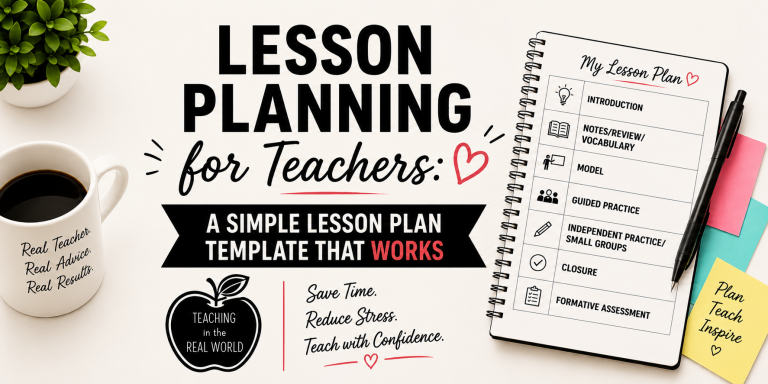
You sit down to plan your week (I typically do this on Thursdays); you have your district scope and sequence, your state standards, and your curriculum in front of you. I always use the same lesson plan format, so that helps to take out the guesswork; try out my lesson plan format, I have a Free Teacher Resource and a video to walk you through it.
.png/:/rs=w:1280)
- First, I look at what content I will be covering for the week (this is typically dictated via curriculum or the district’s scope and sequence).
- Begin planning my topics for each day using bullet points (check out my Teacher Resource).
- Based upon my bullet point lesson plans, activities, and formative assessments, I construct a lesson objective.
- I ask myself: What do I want the students to know?
- I use my list of verbs to help write the objective.
- I ask myself: How will I know that they met the goal?
- I include the formative assessment from my plan book.
By constructing my lesson plan first, it is very easy to write out the objective. I already know what activity my students will be doing (this dictates my Bloom’s verb), and I always have some sort of formative assessment (this dictates how I will make my objective measurable). Since I use the same lesson plan format every day, writing out these lessons and then the objective can be done pretty quickly. It is all about consistency and doing what works, and if you use my format for lesson planning in the upper grades, this process will go very quickly.
Okay, I Wrote the Objective…Now What?
Now that you have planned your lesson and written an amazing lesson objective, it is time to share it! Don’t hide your hard work; post that on the board and let your students know what you expect from them. I always state my lesson objective at the beginning of my lesson; I keep the language academic, but explain the meaning to students if necessary. By clearly defining what you want your class to learn by the end of the period/lesson, you are setting them up for success and guiding their focus in a clear direction. If you want your students to do something, you have to let them know what you want them to do!