First Week of School Ideas: Set the Tone for the Entire Year
Setting the Tone…These first week of school ideas have worked in my classroom for years, and I know this realistic approach to classroom management at the start of the school year can help you too! Setting classroom expectations for upper elementary and middle school students can be tough, but with these back to school teacher tips, your first week back will be a breeze. Remember, realistic changes empower the real-world teacher.
The start of every school year is so exciting and full of possibilities! For upper elementary and middle school teachers, first impressions have a significant impact on pre-teens, tweens, and young adults. The first week of school can determine the tone, mindset, and, most importantly, buy-in from your students. I have the perfect formula from a real-world classroom to set the stage and have an amazing year. Implement these realistic classroom management strategies, and you will set the tone for the entire school year. If you are looking to have a focused, engaged, and productive year, keep reading; I have got you covered.
Set Clear Classroom Expectations on Day One

We all know that students in upper elementary and middle school classrooms are extremely observant, extremely judgmental, and constantly looking for wiggle room to do what they want. The best thing that you can do during the first week of school is to set strong and clear boundaries—have your boundaries, policies, and procedures set in stone. We all know that tweens can smell blood in the water, so do not deviate from your policies, do not make exceptions, and do not let anything slide; stand your ground and stick with your plan. Now, with that being said, you can smile, you can have fun, you can get to know your students, but do it all while sticking to your behavior plan, class schedule, and academic expectations. Clear communication of your real-world expectations is the best way to set the tone for the year.
Why Assigned Seats Make Classroom Management Easier
Save yourself a huge headache, and have assigned seats from day one! I know that many teachers want the students to choose their seats; they want to see who will pair up, who will choose the front of the classroom versus the back, and so on. I encourage you: DON’T let students choose their seats. First off, that is a lot of social pressure placed upon this age group, and second, you want the students to be focused and to listen to the important information that you have to relay. If students are feeling anxious about picking a seat, or if they choose to sit next to a friend that distracts them, they will miss out on all of the vital information that you are sharing. Even if students are simply seated in alphabetical order, choosing the students’ seats for them will help to alleviate a lot of behavior issues that happen when students choose their seats. A seating chart will also make your life easier when learning your students’ names, and for this age group, learning their names quickly will mean a lot to them, and a seating chart will only make this easier. Keep things simple and structured, and the first week will be an absolute success!
Organize Your Classroom Before Students Arrive

Classroom setup can make a huge impact on your students’ perception of you, as well as a huge impact on their behaviors while in your classroom; if you need a little guidance regarding classroom setup ideas, check out my blog post. An orderly classroom will help your students to see your expectations. What I mean is that when things are organized and there are clear systems in place, your students know that it is NOT going to be a “fly by the seat of your pants” kind of year. When they see your organization, you set the expectation, and they understand that this classroom is a place where things get done! Remember to keep it clean, have a space for everything, and have everything in its place; leave no room for error or interpretation from the start. You are setting the stage for the rest of the year, and it is going to be a great year!
Start Teaching Academic Content During the First Week
The first week of school is such an important time! You want your students to feel comfortable, you want to take the time to get to know them, but the message that academics take precedence needs to be communicated. Jump into academic learning as soon as possible. I would typically begin this on day two, and I only found success with this timeline! Many teachers won’t start academics during the first week of school, and unfortunately, this leaves too much idle time for students, too much fluff, and it leads to a lot of off-task behavior. Of course, you will have fun with students and get to know them, but your main goal is to teach them, so you need to connect with their academic abilities and needs during the first week, as well. There is nothing wrong with giving a pre-test during the first week, completing your first notes page in their ISN, or playing a game of class Jeopardy—just dig into your subject matter ASAP! You will be able to learn even more about your students by observing their academic needs. The only way to do this is to start teaching academic content—no later than day two.
Here are some realistic ways to dive into academic content:
- Set Up Interactive Student Notebooks
- Set Up Data Folders
- Review Content From Previous Grade
- Try Close Reading
The first week of school is a great time to really get students used to the flow of your classroom, teaching style, and expectations. I use the same lesson plan and lesson objective format every day, and this is a routine that really helps my students to feel comfortable and clear about their expectations. During these first couple of weeks, you can really set the foundation for your classroom routine.
Simple Getting-to-Know-You Activities That Actually Work

Of course, you want to get to know your students as much as possible, but remember, you have an entire school year to do this; it doesn’t need to happen in the first week. What I mean is that you need to try to limit the “getting to know you” activities. I know, you are likely shaking your head, but hear me out. You can do “getting to know you” activities; you can play games, ask questions, and get to know what makes your students tick, just don’t go overboard. Limiting these activities will make them more meaningful and will keep your students engaged during the activities.
- Keep “getting to know you” activities to 5-10 minutes per class.
- 2-3 Activities during the first week–MAXIMUM.
- Keep activities light, surface-level.
Keep the “getting to know you” activities fairly quick, ten minutes at most, and believe me, that ten minutes will be enough, I promise. The reason for this is engagement; you want these older students to remain engaged for the entire time. If you dedicate too much time to these activities, then students become bored, agitated, and will get severely off track. It is super important to get to know your students, but choose two to three activities for the entire week; any more and students are not going to want to participate, and they will be burnt out! Lastly, keep the activities somewhat surface-level. What I mean by this is that you don’t want to get too personal. Upper elementary and middle school students are sensitive, going through tons of changes, and many of them are insecure. Give them a safe place to share a little about themselves, and allow them to grow their confidence in the classroom by sharing what they feel comfortable sharing.
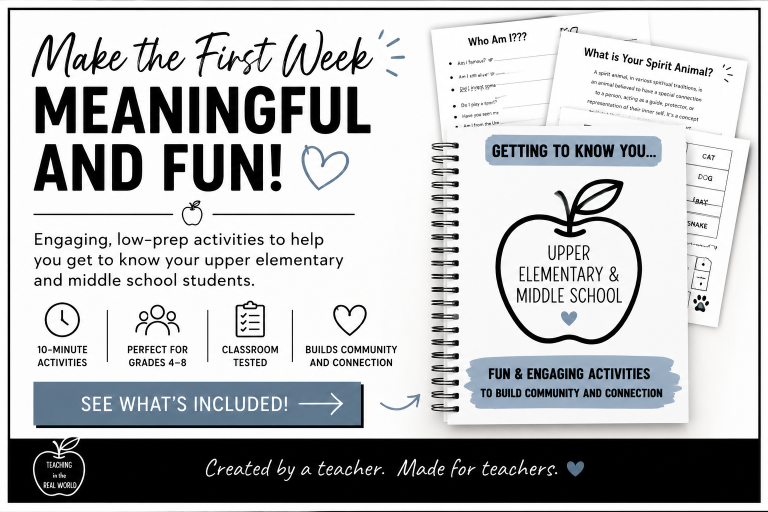
Here are some ideas that have worked in my real-world classroom. Check out my Digital Download:
- Who Am I?
- Students have a famous inventor, author, singer, artist, athlete, etc., taped to their back and must try to guess who it is by asking other students yes/no questions.
- This activity helps students to start conversations with one another without pressure. Be sure to provide sentence starters and/or sample questions.
- Bingo
- Students go around the classroom and try to fill their bingo cards with their classmates’ names.
- Keep the bingo cards light with simple questions that students can easily ask and answer (birthday months, eye color, type of tennis shoe, favorite foods, summer trips, etc.)
- Spirit Animals
- Ask students to choose a spirit animal and provide an explanation as to why they chose that animal.
- Have students share within their groups, or during a stand-up, pair up. Depending on your class size, it is not ideal to share with the entire class, and it will take a lot of time. Check out my Teacher Resource for Cooperative Learning for ideas to help students share.
- Would You Rather
- Lead the class in a school-appropriate game of Would You Rather
- Up the ante and have students physically move around the classroom depending upon their answer. Physical movement can help students connect to the activity, but it is also a great visual and allows them to “see” peers who feel the same way. This is a great way to connect students and start friendships
What Teachers Should Share with Students (and What to Keep Private)

Upper elementary and middle school students are nosy—and I mean this in the nicest way! They want to know about you; they want to connect with you–which is absolutely amazing. Let your students get to know you to an extent…choose one or two things that you feel comfortable sharing with students, and leave it at that. Why only one or two things? Well, you want your students to connect with you, but your private life is just that—private. Remember, you can be friendly with your students, but they are not your friends. Oftentimes, with this age group, if you give them an inch, they take a mile. If you share too much, you risk them thinking that you are friends, and then they begin to ask for “favors” or exceptions, and that is not a place you want to be in. I usually choose to share about my pet and a hobby. But here are some things that many students can connect with, and make your students see you as a “real person.”
- Pets: This is a safe and easy way to connect with students; they love hearing about your pets and seeing pictures.
- Children: This is great if they are not in the same school or campus, and won’t be…otherwise it can get sticky.
- Sports Teams: This is a way for students to connect with you, and can create a lot of different talking points.
- Hobbies: Students love to hear about how you spend your free time; keep it light and positive.
- Baking
- Hiking, Biking, Running
- Crafts (crochet, scrapbooking, woodwork, etc.)
- Fishing
- Collections: This helps students to give you an identity, and it makes it easy for them to get you a gift if they so desire.
- Travel: This can open doors to students about the world and inspire them to travel when they are adults (although I know for many teachers, this is a tough hobby to have on a teacher’s salary).
All in all, sharing a little about yourself will help your students connect with you, and when a student feels connected, they feel comfortable asking for help, guidance, and more.
Fun First Week of School Activities with an Academic Purpose
Now, just because you aren’t spending all day on “getting to know you activities,” doesn’t mean you can’t have fun! Yes, you will want to get into your normal routine and schedule from day one, and you need to start teaching content by day two, but it can still be fun!
- Read Aloud
- A great way to introduce new topics to the class.
- Upper elementary and middle school students love to be read to! They may not want to admit it, but I know this to be a fact.
- Jeopardy
- Review content from the previous grade level.
- Use the game as an academic gauge for your students.
- Foldables
- Have your students create flip books, cootie catchers, and any other type of foldable to organize new information.
- This will give you great insight into their motor skills and ability to follow directions.
- Bingo
- Math, math facts, and math vocabulary are great for bingo.
- Grammar, scientific method, historical events, and more! All of these are great bingo card themes.
Fun in the classroom is easy; it is all about how it is presented to students. Keep your fun academic and on track, and you will set the stage for a year full of learning.
The real-world classroom is a busy place—especially during the first week of school. Help your students to understand and meet your expectations from day one with my realistic solutions for your classroom management. This is going to be the best year ever! You can do this!