Minimalist Classroom Ideas: Create a Warm & Functional Classroom
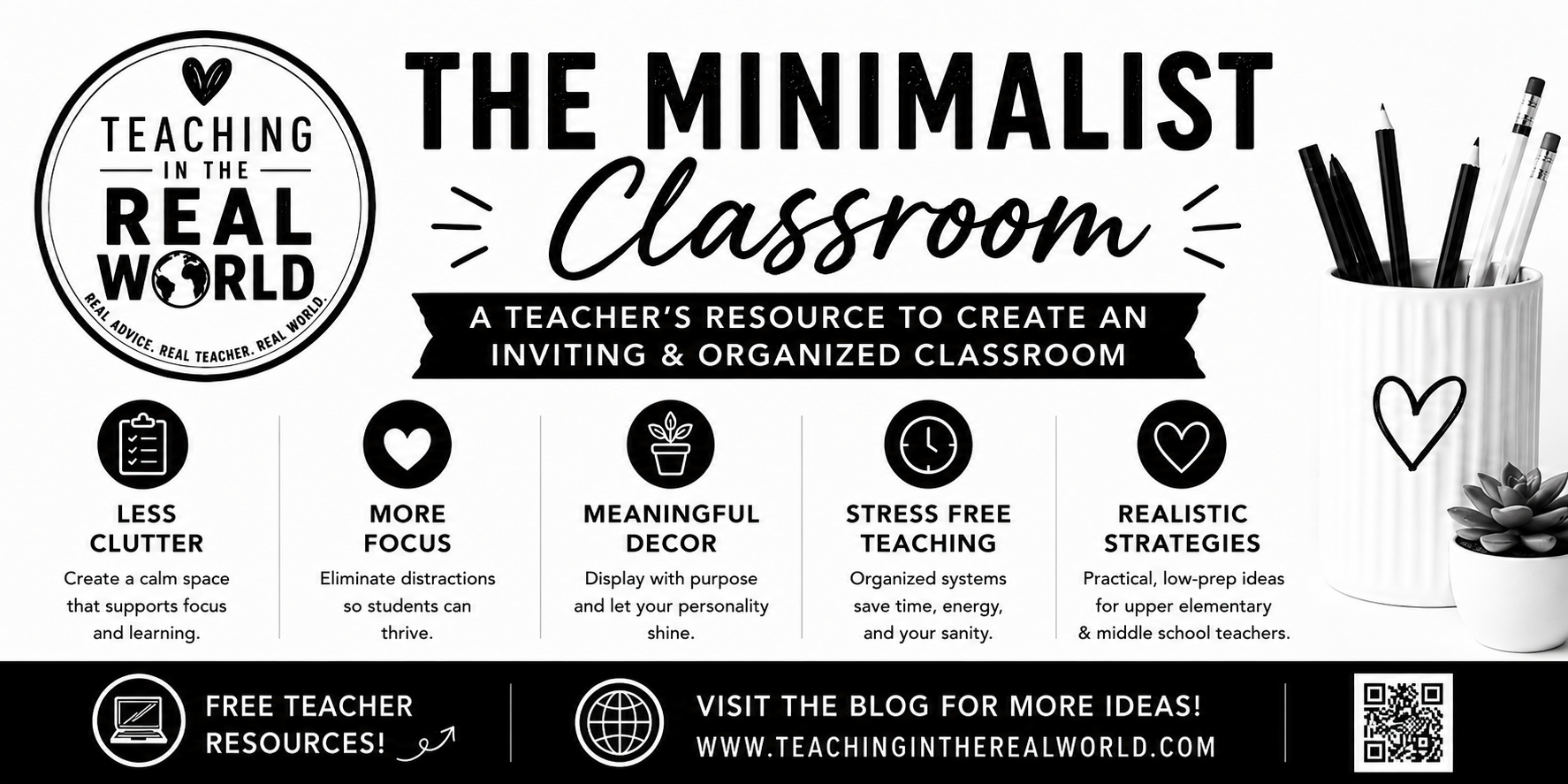
The Minimalist Classroom: A Teacher’s Resource to Create an Inviting Classroom and an Organized Classroom.
Your classroom is your home away from home. Both you and your students spend so many of your waking hours in the classroom, making it so important to create a zen environment that is conducive to learning. Having a clean, organized, and calming space provides the perfect environment for ideas to thrive and learning to excel.
Minimalist Doesn’t Mean Beige and Boring
Now, you might be wondering what I mean by the term minimalist classroom, and what I truly mean is to create a calm classroom. A simplified classroom set-up that is focused on classroom organization.
A Minimalist Classroom is NOT:
- Beige (unless you enjoy the color, which is perfectly fine).
- Cold and Stark.
- Empty.
- Sad.
A Minimalist Classroom IS:
- Clean.
- Free of Clutter.
- Organized (every item has a place and purpose).
- Warm.
- Inviting.
- Conveys Your Personality.
To me, a minimalist classroom has purpose. It does NOT mean filling every inch of the walls with anchor charts, inspirational posters, and vocabulary terms. It does NOT mean that bulletin board borders should frame every hanging item, or even that you should have all matching bins and organizational tools. What it does mean is that your room is well thought out, and that anyone who walks into the room knows what your purpose is–to provide the best education possible to your students.
Why You Should Become a Visual Minimalist
The term or idea that we become “blind” to certain things is very prevalent in the world. For example, we hear all the time on social media that people are “blush blind,” or “eyebrow blind,” meaning they can’t see that they are overdoing it in the blush or eyebrow pencil department. Well, kids become blind to things that are always there as well. If you have children at home, you know all too well the cries of boredom each weekend, which are in turn accompanied by your utter confusion because there is an entire playroom or bedroom filled with toys and activities. The children don’t see them, because they are always there; it is like the items don’t exist, they have become the background, the horizon, it is just there. This same phenomenon happens in your classroom. Students don’t see all of the items that you have stapled onto your walls; it doesn’t stand out to them, although you are trying to make an impact. Those inspirational posters and informational charts are becoming the background of your classroom, not the tools that you hoped they would be for your students.
Visual Minimalist Experiment
The students in your classroom are so used to all of the things on the walls that the hanging items become the background, and they tune them out. For example, I left anchor charts on the wall that contained information that would be very helpful during a summative assessment. The formulas that are most often forgotten and the vocabulary terms that are commonly mixed up were all left hanging on the wall during the test. 48 hours after the test, I conducted my test talk and shared with the class that almost 75% had missed the questions that were related to the anchor charts. I then shared with the class my astonishment, as the anchor charts had been hanging on the wall during the test. No one had noticed. No one used the information that was hanging right in front of them. Most of the class missed the same questions. Why? The walls were cluttered, and it was another thing for them to tune out; it was just the background to their day. What if you made your class and its visuals the foreground? What if what you placed on your walls held such weight that it was never overlooked? What if the resources and anchor charts that you spent so much time creating were used for their intended purpose? A visually minimal classroom will do this!
What Should Go on the Walls?
You should still put things on your walls! You just need to do so with careful purpose. Your style and flair will still shine through; you just don’t need to cover every single inch with inspirational posters, bulletin board borders, butcher paper, fabric, etc. I promise, if you take on this perspective regarding what you hang in your classroom, it will still feel inviting. Here are the musts, put your own spin and style into these purposeful hangings:
- Learning Objectives
- These are likely written on your whiteboard and updated daily.
- Change the color you write them in each day.
- Refer to your learning objective at the start of each class and during the closure of your lesson.
- Class Norms/Class Contract
- Your class rules and guidelines should be hung where everyone can see them.
- Needs to be visible and referred to often (especially when students are not following the guidelines).
- If you have multiple classes, hang your class norms for every single class/period.
- Word Wall
- Word walls are vital for every subject; increasing your students’ vocabulary will benefit them more than you know!
- Do not include definitions, just the word, be sure it is written clearly and can be seen by the class.
- Use your word wall! Refer to the vocabulary terms, and point to that wall! Typically, all words written on the wall are also defined in the ISN, so make your students look up the words that they cannot remember.
- Data
- Data is vital to the classroom in this day and age and is often a requirement to post class progress (sans names, of course).
- Create a data board that celebrates the students’ accomplishments while still presenting valuable data.
- Use your data board while conducting test talks, and refer to the data often. Help students to give the concept of grades a tangible aspect.
Purposeful Classroom
Every teacher has a purpose in mind when putting their classroom together, and I know that classrooms don’t always have the dream furniture, layout, or size, but you have to be purposeful with the flow and placement of items in your classroom. In my minimalist classroom, I have had parents, administrators, and special education teachers comment on how inviting the room felt. Everyone who entered felt as though they could move around. Every table, storage bin, desk, and shelf had a specific purpose. I created a space for everything I would need, and held true to that space, ensuring that students would be able to turn things in, put supplies away, and access learning manipulatives. You must put things away and get rid of things you don’t need. If you need some advice on this topic or are unsure where to start, check out My Blog post. Finding a place for everything you need and getting rid of the things you don’t need is absolutely freeing. Your mind is already full, your to-do list is long, don’t clutter your day with clutter.
Define Spaces
One way to create an inviting room is to have clearly identifiable spaces. Students know where small groups will be held, where supplies are stored, and where to turn in work or retrieve their data folders. By getting rid of items you don’t need, you free up space for the things you do need.
- Teacher Zone
- Your desk is your space; put your personal touch on this area!
- NO drop zone, this is NOT where students turn in papers or missing work! Only you may place items on your desk.
- Hang your standards on the wall next to your desk (admin loves this, and it is a great way to track your progress, plus it lets students see where the class stands).
- Student Paper/Assignment/ISNs Zone
- A system for students to turn in assignments.
- A system for work that is ready to be handed back.
- Extra Papers Bin (check out my Teacher Resource).
- A place to house ISNs (if students do not keep them in backpacks).
- Computer Zone
- Desktop Computers.
- Charging stations for other devices.
- Any other classroom technology is housed in this area.
- Manipulatives and Learning Tools Zone (things that are not used every day)
- Math manipulatives.
- Different types of papers, notebooks, etc.
- Markers, highlighters, crayons, etc.
- Small Group Zone
- A table to hold intervention groups.
- Supplies that could be needed for a small group.
- A place to store your intervention group spiral/documentation.
By creating these zones and really taking the time to functionally map out your classroom, everything will flow easily. The upkeep of the classroom will also be much simpler; there is no guessing as to where to put anything, and each zone is clearly defined.
Get Students Involved
Some of your students spend more waking hours in your classroom or at school than they do at their own homes! It is crazy, but true, and they need to take pride in their classroom. Have your students take the last two minutes of each class to put things away. To make sure that everything is in the appropriate zone and to tidy up their room. Be consistent with your class and keep them involved in the upkeep of the classroom; there is no excuse when everything has a place!
A minimalist approach to your classroom does not mean it has to be boring or empty; it means your classroom should be functional and purposeful. Stock your room with items you will actually use, organize the flow of your classroom to fit your teaching style and needs, and above all, resist the urge to fill every piece of wall with an inspirational poster. Your students will thank you for it, and your mind will be able to focus on the most important thing–teaching. You can do this!