Classroom Hand Signals: A Simple Way to Stop Student Shout-Outs
Classroom hand signals are one of my favorite classroom management strategies for reducing student shout-outs and interruptions without discouraging participation. If you’re tired of off-topic questions sending your lesson down a rabbit hole or students talking over one another, a simple hand signal system can help.
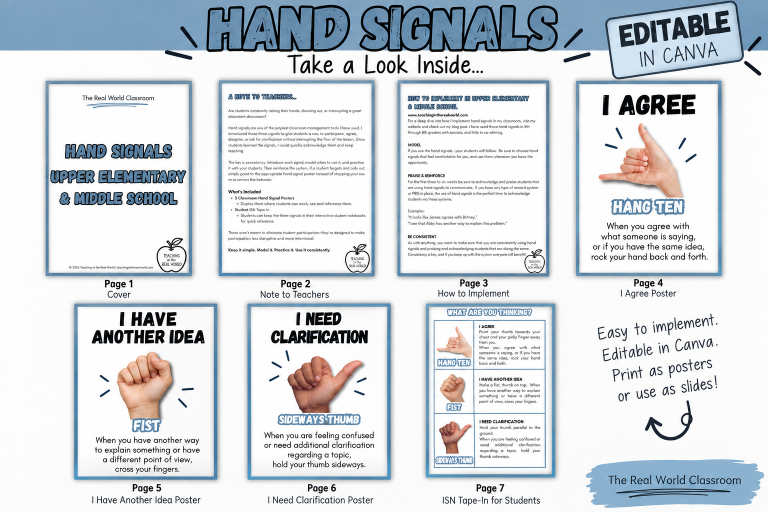
Hand signals give students a nonverbal way to communicate their thoughts, questions, and responses while helping you keep your lesson moving. I have used this classroom management strategy successfully with upper elementary and middle school students for years.
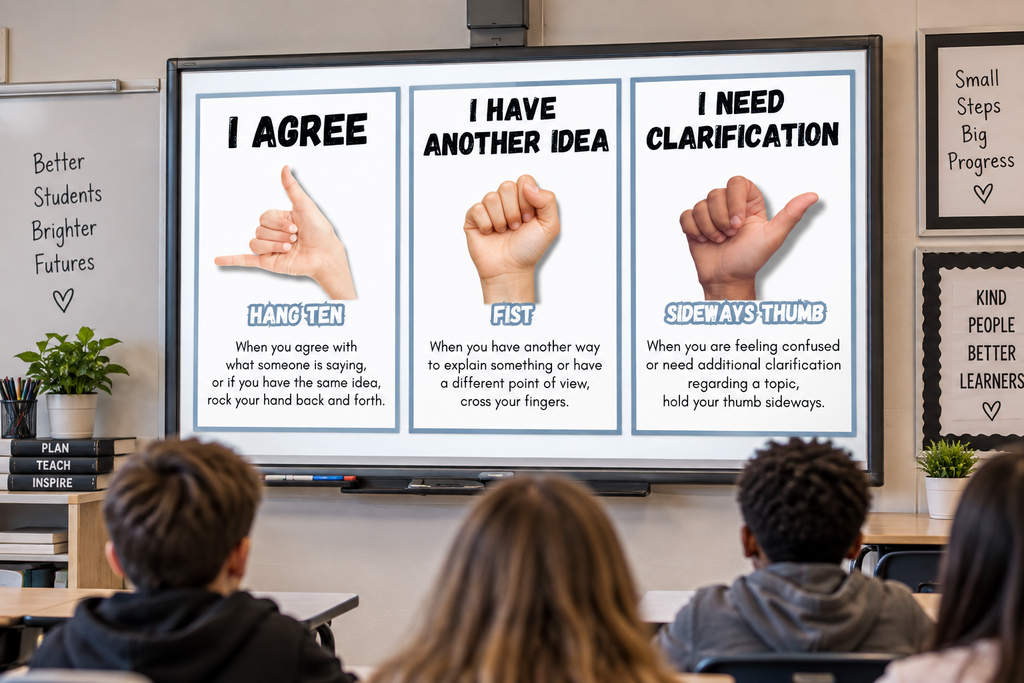
The best part? You don’t need a complicated system. I use just three classroom hand signals to help students tell me:
- I agree.
- I have another idea.
- I need clarification.
These simple signals help students feel heard and acknowledged without shouting out or interrupting instruction.
Classroom Hand Signals: A Simple Way to Stop Student Shout-Outs
This classroom management approach does not address simple tasks like sharpening pencils or going to the bathroom. With my older students, those systems are in place and require little to no monitoring on my end. This management system is designed to prevent students from doing the following:
-Talking over each other.
-Repeating the same answer or viewpoint.
-Sharing an idea that is off topic.
-Asking questions at inappropriate times.
-Engaging in a sidebar conversation.
I encourage you to use my system in any capacity and for any purpose you see fit! I am here to help, and I hope that my free Teacher Resource will help too. Happy Teaching!
Why I Use Classroom Hand Signals
We work so hard to plan amazing lessons for our students! Everyone thinks teaching is so easy, but have them present a lesson or topic for the first time to 32 students, and they will be singing a different tune. As teachers, we take the time to plan introductions/anticipatory sets, modeling, guided practice, and so much more! Scaffolding along the way, making accommodations, and ensuring that the information is accessible to all students are par for the course. Planning takes time, and it is a vital part of teaching, so when it is derailed by student interruptions that can send the whole class down a rabbit hole, it can be discouraging, frustrating, and downright irksome! Sometimes it just takes one student shouting it, and the rest of the class quickly follows. Sometimes a student has a great idea, but it isn’t quite the right time to get to that point; they just need to be patient, but they still want you to know that they know where your lesson is going. My classroom management system helps to acknowledge those students without the “spoiler alert” for the rest of the class. We love our students who participate, who think ahead or outside of the box, but let’s teach our students how to respectfully express themselves and get involved in your amazing lesson.
How Classroom Hand Signals Help With Classroom Management
As teachers, we are excited that our students are showing interest, are listening, and are engaged, but it is important for the class and the lesson to stay on track. I have the perfect solution to stop the shouting out, avoid the rabbit holes, and make every single student feel heard and stay engaged–HAND SIGNALS!
I know what you are thinking, “Huh?!?!” Or maybe you are thinking that you just are not the hand signal type, at least this is what I thought until I saw the impact it had on my students and their engagement. In addition to keeping my students engaged, I found that my lessons were flowing better, I was able to offer better support, and we were able to stay on track with the topic. Because we were on track with our lesson, we didn’t run out of time; we were able to have plenty of guided practice, and formative assessments were always completed. These simple hand gestures changed everything, and now I can’t imagine teaching without them. Not sure where to start? Check out my step-by-step free printable teacher resource.
3 Classroom Hand Signals I Use With Students
The first step in making this work for you is to choose hand signals that you feel comfortable with! The signals you pick must be ones that you will use and don’t feel silly doing. For me, this was a breakthrough moment with using hand signals; as an upper elementary teacher, I wanted to still look cool, but have control over my students. I didn’t feel as though “Quiet Coyote” was for me, or the older students that I taught, and once I realized I could do whatever I wanted, it was a game-changer. Here are the hand signals I implemented that even my most defiant, popular, and shy students were totally on board with: hang ten, fingers crossed, sideways thumb. Let’s dive into each hand signal and their meaning; if you need more of a visual, click into my teacher resource with free printable posters.
What Are Classroom Hand Signals?
Classroom hand signals are nonverbal gestures students use to communicate with their teacher during instruction. They can help students participate, agree with another student, share a different idea, or ask for clarification without interrupting the lesson.
The 3 Classroom Hand Signals I Use
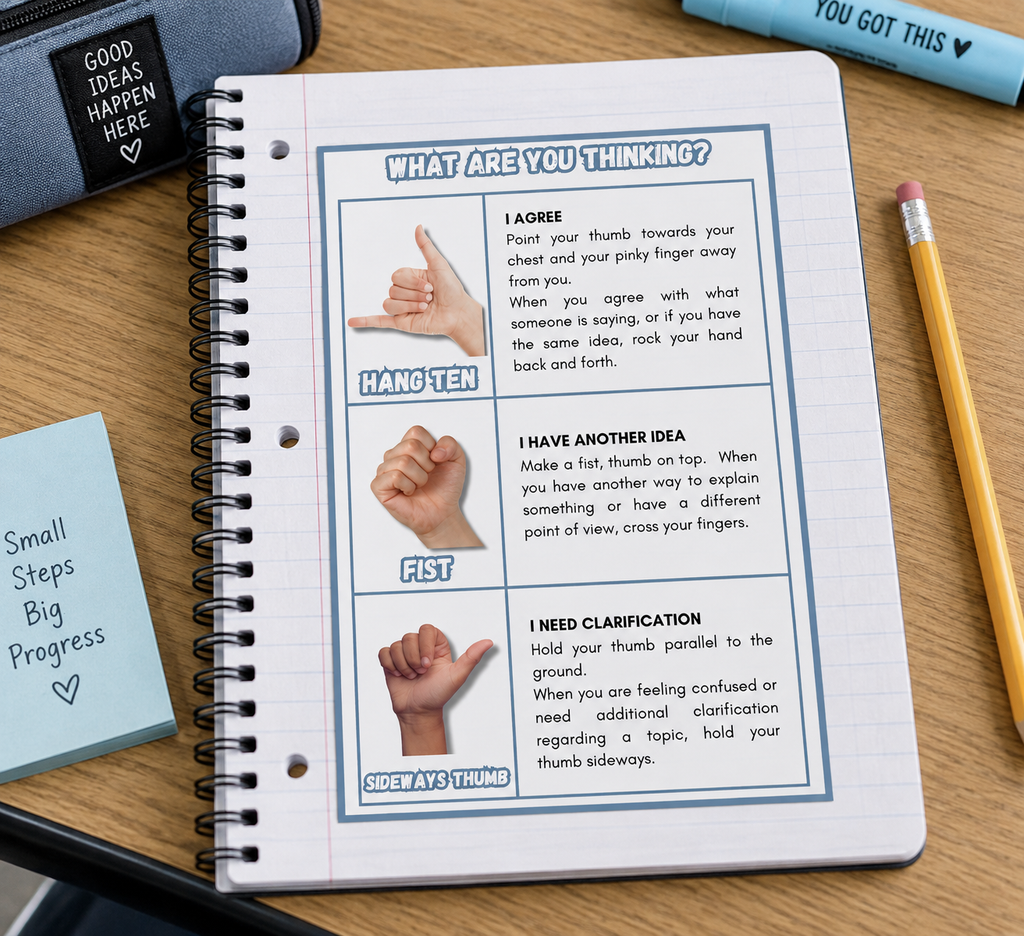
- Hang Ten — I Agree
- Fist — I Have Another Idea
- Sideways Thumb — I Need Clarification
Hand Signal #1: I Agree — Hang Ten
The hang ten hand signal is used when students have the same thought as either you or another student. It is a great way to show that they agree with someone else, and were thinking the same thing. Students use this hand signal while pointing their thumb towards them, and their pinky towards the person they agree with. They move their hand back and forth to show that they have the same idea and/or way of solving a problem as another person. This allows students to feel validated, the class can see what they were thinking, and they will be able to see other like-minded students who are making the gesture at the same time. This is the most used hand signal, and students love to be able to show what they are thinking, but in a quiet way. This is the perfect way to avoid students repeating the same answers in order to receive validation for their thinking. By using the “hang ten,” the teacher can silently nod or give the students a verbal shout-out for having the same idea or coming to the same conclusion.
This hand signal is one that I saw my upper elementary and middle school students use the most, even outside of the classroom! You know you have utilized a management strategy to its full advantage when you see your students making this gesture while talking to their friends in the cafeteria. Students love to be able to express themselves, especially if they are maybe shy or quiet; this is such an easy way to show what they are thinking.
Hand Signal #2: I Have Another Idea — Fist
A fist is a great way for students to show they have a different point of view or another approach to solving a problem. If you are looking for multiple ways to solve a math problem, it is super easy for students to show that they took a different approach. This also works when looking at different points of view in a story, expressing a hypothesis for a science experiment, and so much more. By simply making a fist, students can communicate to the class that they have a different approach or solution.
From a teacher’s point of view, this is a great tool to help in calling on students; you will be able to have students with different conclusions share, and can really open up your lesson for some great conversations–all done without shouting out, talking over others, or arguing. We want our students to think outside of the box and to share their thoughts, but we want them to do it respectfully, and a hand signal can do just that.
.png/:/cr=t:0%25,l:0%25,w:100%25,h:100%25/rs=w:1280)
Hand Signal #3: I Need Clarification — Sideways Thumb
The sideways thumb indicates that students need more explanation or are unsure about the topic at hand. By holding up their thumb sideways, they can easily show that they are confused and can help you to see who might need extra help and/or who needs to be pulled for a small group intervention. It can also guide you to additional problems or situations to model again or engage in additional guided practice. Students can quietly and discreetly show you that they are not quite grasping the concept that you are introducing, and because they can express this, they will, in turn, feel supported. No need to hold their thumb high in the air, or draw attention to it, students can be subtle and feel safe to let their teacher know that they need a little extra support. The use of this hand signal lets students know that it is okay if they don’t understand, and that you see that they need extra support and will help them.
Why Are Classroom Hand Signals Effective?
You might be wondering how these simple hand signals are so effective, right? It is because these signals offer something so important to students: the power to express themselves! The main reason that a student shouts out is that they need to be heard, they want to share, and this is a silent way to make that happen. The other reason most shout out is that they are in need of attention, and using the hand signal allows you to either silently acknowledge students or give them a verbal shout-out in front of the class; it all depends on the student and their personality.
Hand signals also offer a safe and quiet way for students who don’t often ask for help or raise their hands.
- Students can use the hand signal in a way that only you can see (great for quiet or shy students).
- Hand signals even the playing field, so all students are heard, not just the loudest students.
- Most students can make these hand signals, no matter their ability level (if not, accommodations are easy to create)
Once I started implementing hand signals, I found that I had a more productive class, students were more focused during lessons, and I felt as though I could “see” the students and their needs more clearly
How to Teach Hand Signals to Students
Model Your Classroom Hand Signals
Like anything, when something is new and shiny, all the students are on board, but interest can quickly disintegrate–don’t let that happen! The easiest way to keep hand signals going is to use them yourself. Honestly, it will become second nature, something that you find yourself doing outside of the classroom, especially the “I agree” signal. If a student shares an answer or point of view, and you agree with it, use the hand signal. If a student is sharing their way to solving a problem, or foreshadowing they might see in a story, or a hypothesis for a science experiment, cross your fingers to signal that you have another way to explain it, or another point of view. Have a student who is talking through something, and you are not following? Hold your thumb up sideways, and let them know that you need additional clarification or explanation. If you use hand signals, the students will too. Show your students that it is safe, easy, and effective–help them to communicate. Remember, as teachers, we wear many hats, and teach more than academics; teaching our students to communicate is something that we must explicitly show them.
Acknowledge and Reinforce Student Hand Signals
While modeling is amazing and does a lot of the heavy lifting regarding getting these signals to become second nature, your verbal acknowledgment is another way to reinforce hand signals. No, I don’t mean that you need to verbally acknowledge every student’s hand signal (that would defeat the purpose), just sprinkle in a few here and there. For example, “Hmmm, it looks like James agrees with Britney,” or “I see that Abby has another way to explain this problem.” Acknowledging different students throughout the day will reinforce the usage of the different signals and will keep student shoutouts to an absolute minimum. Your acknowledgment will also leave your students beaming with pride that you have noticed their participation, which will, in turn, leave them more likely to keep doing it. If a student is communicating by showing a sideways thumb, that acknowledgement will look a little different. Maybe it is a pat on the shoulder, a nod, or a smile. Check in with them quietly away from the whole group or during a small group; a silent and private acknowledgement of the student not quite understanding will mean the world to them, and will encourage them to let you know when they need help in the future. A teacher’s praise is powerful! Use your acknowledgement to reinforce the silent communication that you desire from your students, and they will continue to use their hand signals.
A Simple Classroom Management Strategy That Works
Classroom management doesn’t always require complicated systems. Sometimes a small change can make a big difference.
If student shout-outs, repeated answers, or off-topic questions are disrupting your lessons, try introducing a few simple classroom hand signals. They give students another way to communicate while helping you keep instruction moving.
Model the signals. Use them yourself. Acknowledge students when they use them correctly. Most importantly, stay consistent.
Simple systems work when students know exactly what to do.Real-world teaching tools are simple solutions that make a big impact. If shouting out or students asking questions that veer your lesson off track are disrupting the flow of learning, these hand signals will help. I have seen them successfully used from first grade to high school; hand signals are another way to teach your students to communicate and another way for you to meet their needs while staying on track. Still feeling unsure? Check out my teacher resource with step-by-step guidance. You can do this! classroom management shouting out classroom management shouting out