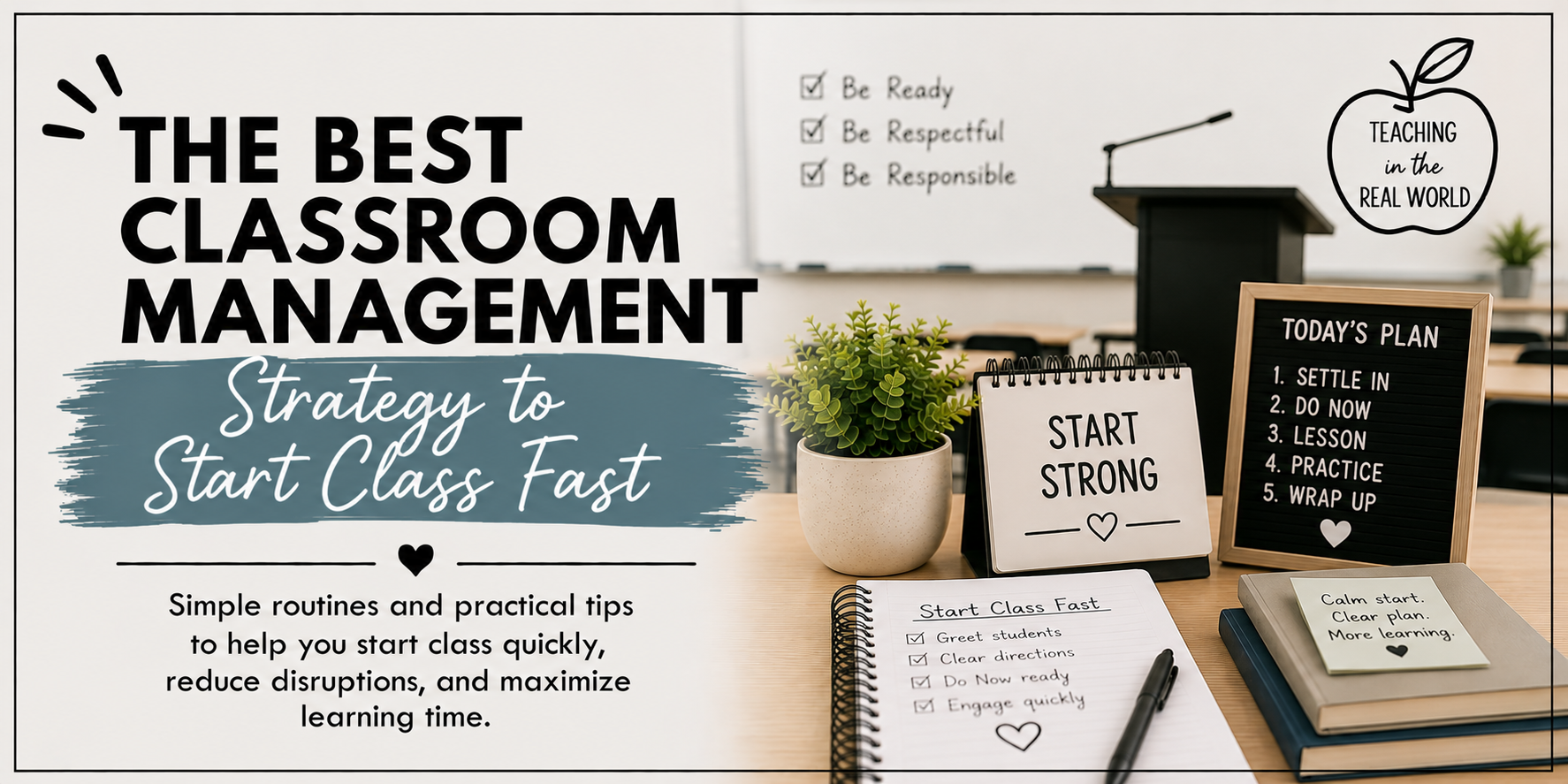
The Best Classroom Management Strategy to Start Class Fast
You know what they say…sometimes getting started is the hardest part. This can be true for anything, but I have found it especially accurate at the start of any upper-grade or middle school class, period, or subject. Getting these students motivated and moving with urgency can feel frustrating, and it can honestly be a real time-sucker! You try to get students prepared for the lesson, check in, get your lesson ready, and the next thing you know, twenty minutes have flown by. Believe me, I have been there…until I found a simple classroom routine that works, will save instructional time, and gets your students moving; this is how I get students focused, settled, start class fast, and ready to learn in about six minutes.
Start the Class Right
The first thing I always do as my students enter the class is greet each one of them at the door. I teach multiple classes/periods, so each new group of students is greeted at the door. I say hello, high-five, or fist-bump to every single student; yes, even though I have 37 kids in a class, I greet each one. This gives the start of the class a great vibe; it lets each student know that you see them, that you are glad they are there, and that you are ready to jump into academics. By standing at the door and greeting each student, which literally only takes a minute, you are setting the tone for the period/class. Students enter the room and know you care, but they also know that you are prepared; you are not running around trying to get things ready or sprinting from the copy room, you are present and focused on the class. You are there to say hello and are ready to teach, which in turn sets the class up to be ready to learn.
Bell Work…Yes, or No???
Before I jump into my tried and true strategy to get your students moving and reading to learn, there is a great big elephant in the room: Should I have my class complete bell work/warm-up problems? This has been debated for many years, and of course, every teacher has their own perspective. I know I definitely have mine, but in the end, you have to do what works for you, your students, and the amount of time you have to teach something. But here is my experience with bell work or warm-up activities…
Please know that I have tried bell work for every subject in the upper grades, and it just never quite works out. The activities typically take too long, and can lead you down a teaching rabbit hole in an attempt to fill gaps that have become evident during bell work. I also felt that it was causing some academic fatigue or burnout in students; it was almost discouraging students from jumping into learning when the actual lesson was starting. I gave bell work a good try, because that is what I thought I was supposed to do, but I just don’t think it is worth the time it takes. I have tried multiple publishers, strategies, and systems when it comes to bell work.
Each time, I am met with the same barriers.
- Bell work always takes three times longer than you think it will.
- It never quite “fits” with your students’ needs or ability levels.
- Someone has always “misplaced” their bell work; lots of extra copies are needed.
Now, if you are a proponent for this activity, that is amazing, but I clearly and loudly vote NO when it comes to bell work or warm-up activities. I don’t find it to be worth the time; I haven’t been able to see a measurable benefit to my students’ performance, and it honestly causes more headaches and takes away time from my lesson. So in place of bell work, my students are greeted with a daily to-do list. It only takes about five minutes, and students are ready to jump into the lesson for the day. To hear more about my thoughts on bell work, check out my YouTube Channel: Teaching in the Real World.
Be Prepared!

Whether you are using bellwork or not, the most important factor in determining the productivity of your students, especially at the beginning of class, is teacher preparedness. As the teacher, you have to have all of your ducks in a row if you want your students to do the same. You do not want students to see you frantic or running around to prep things, remember you are an amazing professional who is prepared and ready. If this is tough for you, take a look at my blog post to help you with time management–it is possible!
Before your students enter the class, be prepared.
- To-Do List Written and Posted
- Objective Posted
- Copies Made
- Document Camera On and Ready
- All Lesson Supplies Out and Ready
The best way to keep your students on track at the start of class is for you, the teacher, to be prepared and ready to go. Be sure to have that to-do list posted on the board, have whatever you need them to copy up on the document camera, be ready to start teaching, and your students will be ready to learn.
The To-Do List
After trying many different methods: smart board slides (time-consuming and needed a laptop), chart paper (not cheap), document camera (couldn’t project notes or other items concurrently), just to name a few, I found that the whiteboard was my best bet. Because I don’t have my students complete bell work, I always have a to-do list up on the whiteboard. I write it before each class, and it only takes about 30 seconds; quick, easy, and low tech–perfect! I place no more than five items on the list, and the list will definitely vary depending on the class or subject that the students are starting.
Although the list changes depending on the lesson, day, and class, I typically have the same first three items every day:
To-Do
- Planner Out and Open
- ISN Out and Visible
- Pencil, Pen, Highlighter
Items #4 and #5 change daily, but some examples include:
- Opening a textbook to a specific page.
- Review or read through notes/vocabulary from the previous day.
- Get out and start grading homework (answer key projected on document camera).
- Begin to copy notes into the Interactive Student Notebook (projected on the document camera).
By having a to-do list written on the board and ready every single day, your students are clear on what their expectations are, what they should be doing, and that these items should be done with urgency. I typically only give 5 minutes for students to complete the to-do list, and then it is time to jump into the lesson for that day. Spending more than 5-7 minutes at the start of class will stunt productivity for the day. If you need a little help keeping time, set a timer, but just keep it short.
Teacher Tasks
While your students are working through their to-do list, it is the perfect time to check in with students individually; another simple way to let your students feel heard and to show you care. Follow up with students who needed some clarification based on their formative assessment from the day before, or check in with students who have any questions from the previous day. This is a great time to make sure that absent students have the assignments they need to make up; you can help students who have missing work locate their assignments, get them the missed notes, or make plans for them to take a missed quiz. The first five minutes of class are also the perfect time to check student planners for parent notes and signatures; this is something I do every day, and although it sounds daunting, it only takes about 90 seconds (check out my YouTube Channel to see how I use student planners each day). The longer you linger, the harder it is to get students to fully engage in the academic lesson, so be sure to watch your time; any task that takes longer than 90 seconds should be saved for a different time during class. Once the first five to seven minutes of class have passed, it is time to bring everyone together and get started on your lesson for that day. You can do this!
This To-Do List sounds very simple, and that is honestly what makes it so amazing. You are giving your students the space they need to be independent and take control of their learning, but you are also offering them support while teaching them a life skill of organization and prioritization. You can’t lose with this strategy! The best part is, your students aren’t fatigued from bell work, they are organized and ready to listen, and they know exactly what to expect each day. I have a To-Do list posted every single day; whether it is a half day, field trip, test, assembly, you name it, I am consistent with my expectations upon entering class, and my students rise to the occasion!